

If you tune your radio to BBC Radio 4 just before one o’clock in the morning, you will hear a hypnotic, rhythmic recitation that has lulled Britons to sleep for a century. Viking, North Utsire, South Utsire, Forties, Cromarty…
It is the Shipping Forecast, a daily liturgy of the seas. But among these poetic names, one area has undergone a transformation so profound it borders on science fiction: Dogger.
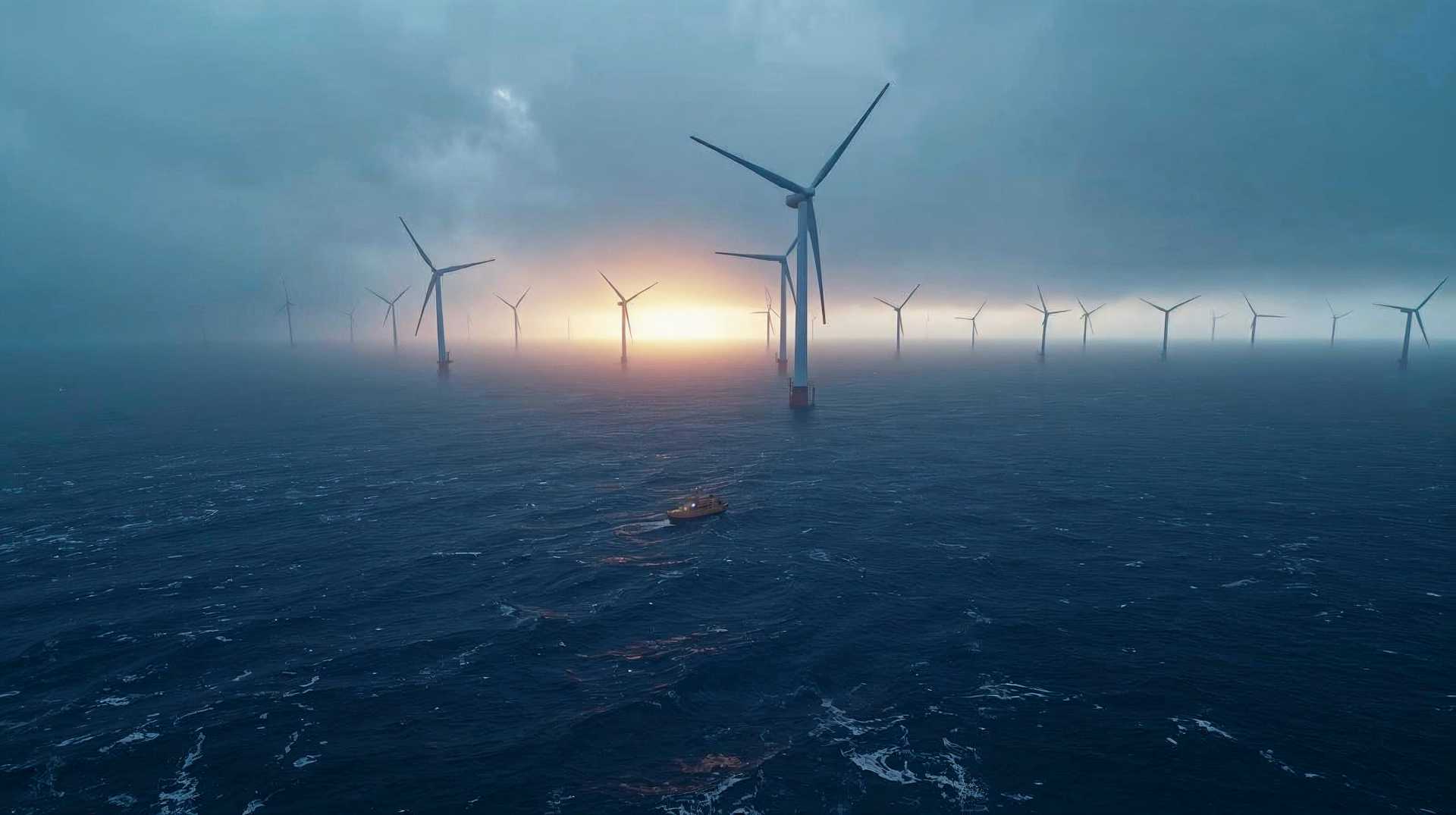
For generations, “Dogger” meant a remote, shallow patch of the North Sea where trawlers hauled in cod and herring. It was a place of fish, fog, and the occasional First World War naval skirmish. Today, however, if you were to stand on the deck of a vessel 80 miles off the Yorkshire coast, you wouldn’t just see waves. You would see a forest of white steel rising from the water, taller than the towers of Canary Wharf, harvesting the invisible rivers of air that flow over the planet.
This is the Dogger Bank Wind Farm. It’s not merely a collection of turbines; it’s the largest offshore power station on Earth. A cathedral of engineering that combines the raw physics of aerodynamics with the brutal economics of global energy markets.
As of early 2026, the final foundations have been driven into the seabed, and the arrays are coming online to power six million British homes. But how does one build a power plant in the middle of a hostile sea? Why is it there? And does the maths actually stack up?
Please note: The content below may contain affiliate links. If you make a purchase through these links, we could earn a commission, at no additional cost to you.
The Ghost of Doggerland
To understand the engineering genius of Dogger Bank, you first have to understand the geology. Why build a wind farm 130 kilometres (80 miles) from the shore? Usually, offshore wind farms are visible from the beach, hugging the coastline to keep cable lengths short and water depths manageable.
Dogger Bank is a geological anomaly. During the last Ice Age, this wasn’t a sea at all. It was a vast land bridge known as Doggerland, a tundra connecting Britain to continental Europe. Mesolithic hunter-gatherers roamed here, hunting mammoths and red deer. As the ice melted and sea levels rose around 6,000 BC, Doggerland was submerged, leaving behind a massive submerged sandbank.
This is the “Goldilocks” zone for offshore wind.
- It’s shallow: Despite being far offshore, the water depth ranges from just 18 to 63 metres. This allows engineers to use “fixed-bottom” foundations (steel tubes driven into the ground) rather than expensive floating platforms.
- It’s windy: The wind speeds here are high and consistent, unobstructed by land for hundreds of miles.
- It’s vast: The bank is about the size of North Yorkshire, offering enough space to space out turbines so they don’t steal each other’s wind (a phenomenon known as wake effect).
The Physics of Catching Ghosts
The machines harvesting this wind are the GE Haliade-X turbines, and they are monsters of the modern age. To call them “windmills” is like calling the Shard a cottage.
The Leviathans
Each turbine stands 260 metres tall—nearly twice the height of the London Eye. The blades alone are 107 metres long. If you placed one of these turbines in Trafalgar Square, the blades would sweep a circle wider than the square itself, clipping the National Gallery and Nelson’s Column.
But size isn’t just for show; it’s a matter of physics. The power a wind turbine can generate is proportional to the swept area of its blades. If you double the length of the blade, you don’t just double the power; you quadruple it (because the area of a circle is $\pi r^2$). By building massive blades, the Dogger Bank developers can capture exponentially more energy with fewer foundations, lowering the cost per megawatt.
Lift, Not Drag
A common misconception is that the wind “pushes” the blades like a child blowing on a paper pinwheel. That is drag, and it’s inefficient. Modern turbines work like aircraft wings, utilising lift.
As the wind flows over the curved surface of the blade, it travels faster over the back (the suction side) than the front (the pressure side). According to Bernoulli’s principle—the same rule that keeps a Boeing 747 in the sky—this creates a pressure difference. The blade isn’t pushed; it is pulled forward. This allows the tips of the blades to travel at speeds of over 180 mph, far faster than the wind itself.
The Betz Limit
You might wonder: why not design a turbine that stops the wind completely to extract 100% of its energy? The answer lies in a fundamental law of physics discovered by German physicist Albert Betz in 1919.
If a turbine extracted 100% of the energy, the wind behind it would stop moving. If the air stopped moving, it would pile up and block fresh air from entering the turbine. For the air to keep flowing, it must retain some speed as it leaves. Betz calculated that the theoretical maximum efficiency of any wind turbine is 59.3%.
The Haliade-X turbines at Dogger Bank operate remarkably close to this theoretical limit, adjusting their blade pitch and rotation speed millisecond-by-millisecond to extract the maximum physically possible energy from every gust.
The Long Tether: Conquering Distance
Generating the power is only half the battle. The real headache is moving it.
Dogger Bank is so far from shore that traditional cables wouldn’t work. The project is built in three phases—A, B, and C—each with a capacity of 1.2 gigawatts (GW). If you tried to send that much power over 130km using standard Alternating Current (AC)—the type used in your house mains—you would encounter a problem called capacitance.
The AC Problem
In an AC cable, the electricity vibrates back and forth 50 times a second. Undersea cables act like giant capacitors (batteries that store charge). In a long AC cable, the copper wire spends so much energy just charging and discharging the cable’s insulation with every cycle that barely any useful power reaches the other end. For distances over 80–100km, AC becomes practically useless.
The HVDC Solution
The solution is High Voltage Direct Current (HVDC). This is the first time HVDC technology has been used for an offshore wind farm in the UK.
- Offshore Platform: The AC power from the turbines is gathered at a massive, unmanned yellow platform at sea.
- Conversion: Giant converters turn the chaotic AC into a steady stream of DC at 320,000 volts.
- Transmission: The DC flows smoothly through the subsea cables with minimal losses, because it flows in one direction and doesn’t constantly charge the insulation.
- Landfall: It hits the coast in Yorkshire (Ulrome for phases A & B, Redcar for C), where another station converts it back to AC for the National Grid.
This technology is the “secret sauce” that makes far-offshore wind farms possible.
The Economics: A Billion-Pound Gamble?
When the project was first conceived, critics laughed. “Too far, too deep, too expensive,” they said. How could building power plants in the middle of the North Sea possibly compete with gas or nuclear?
The answer lies in the Contracts for Difference (CfD) scheme, a mechanism introduced by the British government to de-risk renewable investment.
The Strike Price
In a CfD, the government agrees on a “strike price”—a guaranteed price for the electricity the farm produces.
- If the market price of electricity is lower than the strike price, the government tops up the difference.
- If the market price is higher, the wind farm pays the difference back to the consumer.
Dogger Bank A and B secured a strike price of roughly £39.65 per megawatt-hour (MWh) (in 2012 prices). To put that in perspective, during the energy crisis of 2022/23, wholesale electricity prices spiked to over £200/MWh. Because the Dogger Bank strike price was locked in so low, the project (once fully operational) effectively acts as a buffer, paying money back and keeping bills lower than they would be if we relied solely on gas.
It is a stunning economic victory. Offshore wind, once the most expensive form of green energy, is now one of the cheapest forms of new power generation in the UK.
The Supply Chain
The project is a joint venture between SSE Renewables (UK), Equinor (Norway), and Vårgrønn (Norway). But the impact is local.
The Operation and Maintenance (O&M) base is located at the Port of Tyne in South Shields. This facility is the brain of the operation. It has created over 200 long-term jobs in a region that has historically suffered from deindustrialisation. These aren’t temporary construction gigs; they are 35-year careers for data analysts, marine engineers, and technicians who commute to work by high-speed vessel rather than by bus.
Furthermore, the steel foundations (monopiles) provided work for the UK supply chain, though—in a point of contention—much of the heavy fabrication still occurs abroad due to the sheer scale required. However, the assembly and marshalling at ports like Able Seaton in Hartlepool have revitalised British quaysides.
The Future: Dogger Bank D and Beyond
As of 2026, the construction of phases A, B, and C is nearing its crescendo. The specialised vessel Voltaire, a ship taller than the Eiffel Tower, has been jacking itself up on legs above the waves to install the final turbines.
But the story doesn’t end here. A fourth phase, Dogger Bank D, is currently in the proposal stage. The developers are looking to squeeze even more juice out of the eastern edge of the bank. There is also talk of using this excess power not just for the grid, but to produce Green Hydrogen—using electricity to split water into hydrogen and oxygen, creating a clean fuel for heavy industry and shipping.
Conclusion
The Dogger Bank arrays are a testament to British ambition and engineering resilience. We have taken a piece of the map best known for shipping forecasts and fishing trawlers and turned it into the engine room of the UK’s Net Zero ambitions.
There is something poetically circular about it. Ten thousand years ago, Doggerland was a source of life for our ancestors. Today, rising from the waves that drowned it, the bank is once again sustaining us—not with mammoths and deer, but with gigawatts of clean, silent power.
Further Reading
For those wishing to explore the technical and industrial details further, the following resources are highly recommended:
- Dogger Bank Wind Farm Official Site – The primary source for construction updates and project milestones.
- SSE Renewables – Detailed reports on the development and operation of the arrays.
- National Grid ESO – Real-time data on the UK’s energy mix and the contribution of wind power.
- The Crown Estate – Information on seabed leasing and the future of UK offshore wind.
- RenewableUK – Industry insights, statistics, and policy news regarding British renewable energy.