

It is 7:00 am on a grey Tuesday in Manchester. You stumble into the kitchen, still half-asleep, and flick the switch on the kettle. A tiny red light glows. Within minutes, water is bubbling, ready for that life-saving first cup of tea. It is a ritual performed by millions of us every morning, from Cornwall to the Cairngorms.
But have you ever stopped to think about what happens when you flick that switch?
That simple click sends a signal down a wire, out of your house, and into a vast, invisible machine that covers the entire country. At that exact moment, somewhere hundreds of miles away—perhaps in a windy field in the North Sea or a hollowed-out mountain in Wales—a generator has to work just a tiny bit harder to make the electricity you need.
This is the National Grid. It is the most complex machine in Britain, a silent giant that connects us all. It doesn’t just move electricity; it balances it. Every single second of every single day, the amount of electricity being made must match the amount being used exactly. If it doesn’t, the lights go out.
This is the story of how that balance is kept, and the unseen army of engineers, supercomputers, and mountains that keep Britain glowing.
Please note: The content below may contain affiliate links. If you make a purchase through these links, we could earn a commission, at no additional cost to you.
Part 1: The Heartbeat of Britain (50Hz)
Imagine the National Grid is like a giant tandem bicycle with 67 million people riding it. Some of us are pedalling (generating power), and some of us are just sitting there using the energy (consuming power).
To keep the bike moving smoothly, everyone has to pedal at a steady rhythm. In the world of electricity, this rhythm is called Frequency, and in the UK, the magic number is 50 Hertz (Hz).
If you could listen to the electricity in your walls, it would be humming at 50 beats per second. This is the heartbeat of Britain.
The Tightrope Walk
The job of keeping this heartbeat steady belongs to the National Energy System Operator (NESO). They are like the conductors of a giant orchestra.
- If we use too much power (everyone turns on their kettles at once) and there isn’t enough generation, the frequency drops. The bike slows down. If it drops too low (below 49.5Hz), safety trip-switches flip, and parts of the country plunge into darkness to save the rest.
- If we generate too much power (it’s a very windy day but nobody is using electricity), the frequency rises. If it goes too high (above 50.5Hz), it can damage the expensive equipment that runs our factories and hospitals.
The NESO engineers have to keep the frequency between 49.5Hz and 50.5Hz legally, but in reality, they aim for a much tighter target—usually within 0.2Hz of that perfect 50. They do this 24 hours a day, 365 days a year. They never sleep.
Part 2: The Brain – Inside the Control Room
So, where does this balancing act happen? For years, it was National Grid, but as of 2024, the “brain” of the system is a separate expert body called NESO.
They operate out of high-security control centres, with key sites in Wokingham and Warwick. Picture a room straight out of a spy movie: a giant wall of digital screens glowing with maps of the UK, flashing numbers, and scrolling graphs.
The Pilots of Power
The people in this room are the pilots of the grid. They don’t own the power stations, and they don’t sell the electricity. Their only job is to move it safely.
They watch the weather forecast like hawks. A dark cloud moving over London means millions of people will switch on their lights—demand goes up. A sudden gust of wind in Scotland means wind turbines spin faster—supply goes up. The engineers are constantly calling power stations, asking them to turn up or turn down, keeping that seesaw perfectly level.
Part 3: The Great British TV Pickup
There is one thing that makes the British grid unique in the world: our obsession with a good cuppa.
In France or America, electricity usage is fairly smooth. In Britain, we have the TV Pickup. This happens when a massive TV event—like the World Cup, the Strictly Come Dancing final, or a gripping episode of EastEnders—goes to a commercial break.
The “EastEnders” Effect
Suddenly, millions of people get up from the sofa, open the fridge (letting cold air out), flush the loo (using electric pumps), and, most importantly, switch on the kettle.
A kettle uses a lot of power—about 3,000 watts. That’s 30 times more than a standard 50-inch TV. When a million people do this at the exact same second, it hits the grid like a sledgehammer.
The Record Breaker
The biggest “pickup” in history happened on 4th July 1990, after England lost to West Germany on penalties in the World Cup semi-final.
- The Demand: 2,800 Megawatts (MW).
- The Comparison: That is the equivalent of over one million kettles being switched on at once, or five nuclear power stations starting up instantly.
Today, with Netflix and catch-up TV, these spikes are smaller, but the control room still has a massive calendar on the wall. They know exactly when the FA Cup final is, and they have power stations ready and waiting.
Part 4: The Electric Mountain
When the grid faces a sudden spike—like that World Cup penalty shootout—it can’t wait for a nuclear power station to warm up (which takes days). It needs power now.
Enter the superhero of the grid: Dinorwig Power Station, also known as the “Electric Mountain.”
Hidden in the Hills
Deep inside the Elidir Fawr mountain in Snowdonia, Wales, lies a marvel of engineering. It looks like a villain’s lair from a James Bond film.
Dinorwig is a hydroelectric dam, but with a twist. It has two lakes: one at the top of the mountain and one at the bottom.
- When we need power: They open the giant valves. Water crashes down from the top lake, spins massive turbines inside the mountain, and generates electricity. It can go from zero to full power (enough to run all of Wales) in just 12 seconds. It is one of the fastest response teams in the world.
- When we have too much power: At night, when electricity is cheap and the wind is blowing, they use the excess electricity to pump the water back up to the top lake, ready for the next day. It’s like a giant rechargeable water battery.
Part 5: Anatomy of the Grid
We often call everything “the grid,” but there are actually two different systems working together. Think of it like the country’s road network.
1. The Transmission Network (The Motorways)
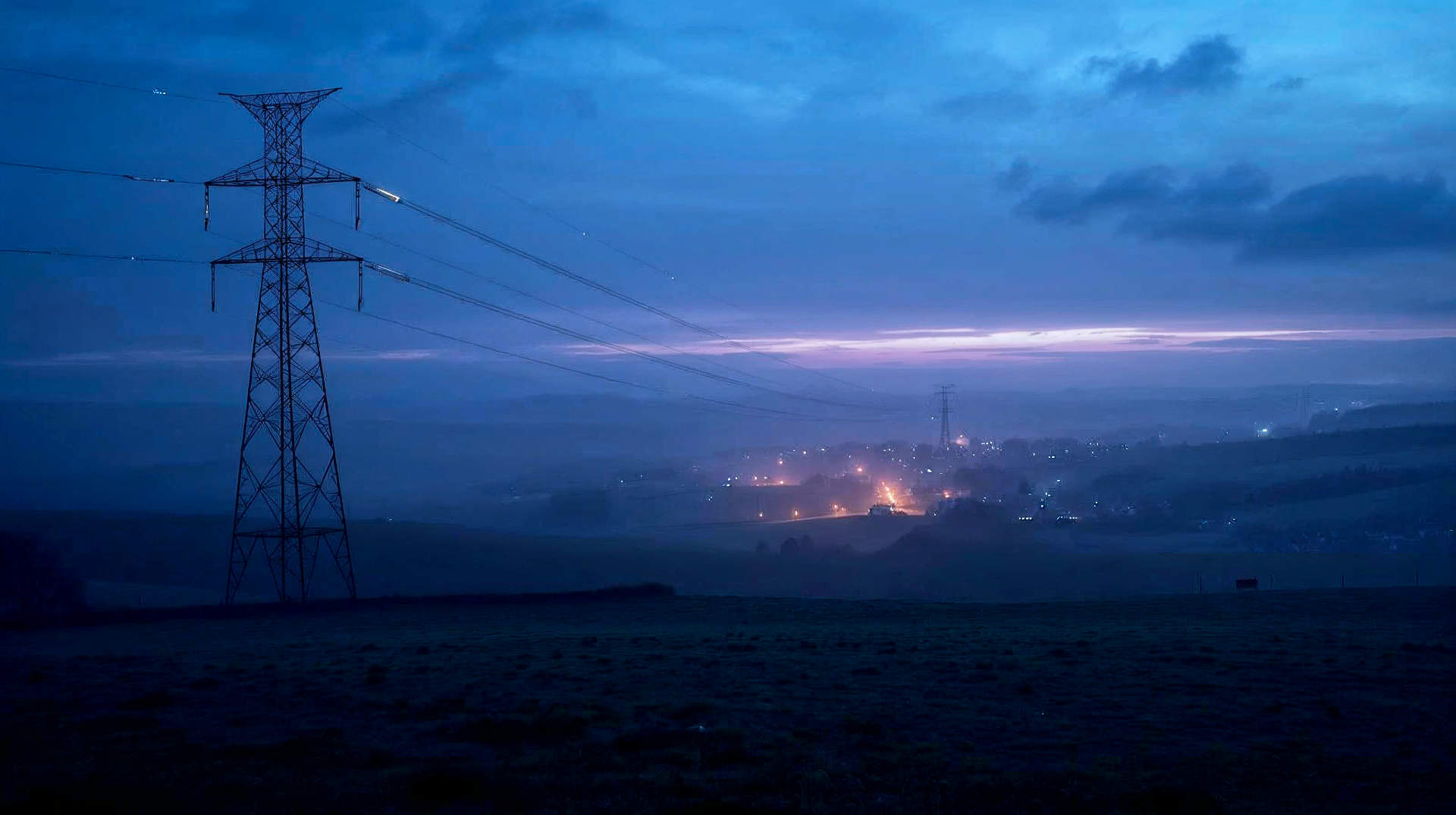
These are the massive steel pylons you see marching across the countryside.
- Voltage: Super high—up to 400,000 volts.
- Job: To move huge amounts of electricity from where it’s made (power stations in the North, wind farms in the sea) to where it’s needed (cities in the South).
- Owned by: Companies like National Grid Electricity Transmission (in England/Wales), SP Energy Networks (southern Scotland), and SSEN Transmission (northern Scotland).
2. The Distribution Network (The B-Roads)
When the electricity gets near your town, it hits a substation. Here, transformers step the voltage down to safer levels (11,000 volts, then 230 volts).
- Job: To deliver power to your front door.
- Owned by: Regional operators (DNOs). If you have a power cut, these are the people you call, not the National Grid!
A Pylon History Lesson
Those iconic steel lattice towers have been with us since 1928. The design was chosen by a famous architect, Sir Reginald Blomfield, who modelled them on the word pylon, which means “gateway” in Ancient Greek.
Today, we are seeing a change. In Somerset, the new T-Pylons are being built. They are white, sleek, and T-shaped, looking more like modern art than industrial gear.
Part 6: The Changing Mix
The electricity flowing through the wires has changed completely in the last ten years.
The Death of King Coal
For a century, Britain ran on coal. It was dirty, but it was reliable. In 2012, coal provided 40% of our power.
Today? It is zero. The last coal power station, Ratcliffe-on-Soar, closed its doors in late 2024. Britain has become the first major economy to quit coal power completely.
The Rise of the Wind
Now, the wind is our workhorse. Britain is one of the windiest countries in Europe. On a blustery day, wind farms can provide over 50% of the country’s electricity.
But wind is fickle. Sometimes it blows too hard (and we have to pay wind farms to turn off!), and sometimes it doesn’t blow at all.
The Interconnectors: Our Energy Neighbours
To help balance this, we have giant undersea cables called Interconnectors. These link us to our neighbours: France, Belgium, the Netherlands, Norway, and Denmark.
- Viking Link: The world’s longest undersea power cable, stretching 475 miles from Lincolnshire to Denmark.
- How it works: If it’s windy in Denmark but calm in the UK, they send us cheap green power. If it’s sunny here but dark there, we send power back. It’s the ultimate energy trade deal.
Part 7: When the Lights Go Out (Black Start)
What is the worst-case scenario? What happens if the entire grid collapses?
It hasn’t happened nationwide since the grid was built, but the engineers plan for it every day. It’s called a Black Start.
You can’t just flip a switch to turn the country back on. Most power stations need electricity to start working (to run pumps and computers). If the grid is dead, they are stuck.
The Reboot Sequence
To restart Britain, we need “Black Start” stations—generators that can start themselves with just a diesel engine or a battery.
- A Black Start station (like a hydro plant in Scotland) fires up.
- It creates a small “island” of power.
- It carefully connects to a neighbour, expanding the island.
- Bit by bit, like stitching a quilt together, the islands join up until the whole UK is reconnected.
Traditionally, we used big coal or gas plants for this. Now, NESO is testing a Distributed ReStart, using wind, solar, and batteries to boot up the grid from the bottom up.
Conclusion: The Silent Service
The National Grid is easy to ignore. We complain when a pylon spoils a view, or when bills go up. But behind the scenes, it is a triumph of British engineering.
Every time you stream a movie, charge your phone, or boil that kettle, you are tapping into a system of unimaginable complexity. From the control engineers in Wokingham watching the weather, to the hydro-plant operators in Wales waiting for the call, thousands of people are working in perfect sync to keep the heartbeat of Britain steady.
So, the next time you flick a switch and the light comes on instantly, give a little nod to the silent grid. It’s the magic that keeps modern life moving.
Further Reading & Resources
For those interested in exploring the fascinating world of energy further, these are the most authoritative sources in the UK:
- National Energy System Operator (NESO): The official body that runs the UK’s electricity system. Their “Data Portal” is excellent for seeing live grid stats.
- National Grid Live Status: A brilliant, community-built dashboard that shows exactly where Britain’s electricity is coming from right now (wind, solar, nuclear, etc.).
- Electric Mountain (Dinorwig): Information on the First Hydro Company and the incredible engineering inside the Welsh mountains.
- Drax Electric Insights: Detailed, quarterly reports on the UK’s power mix, written by academics from Imperial College London.