

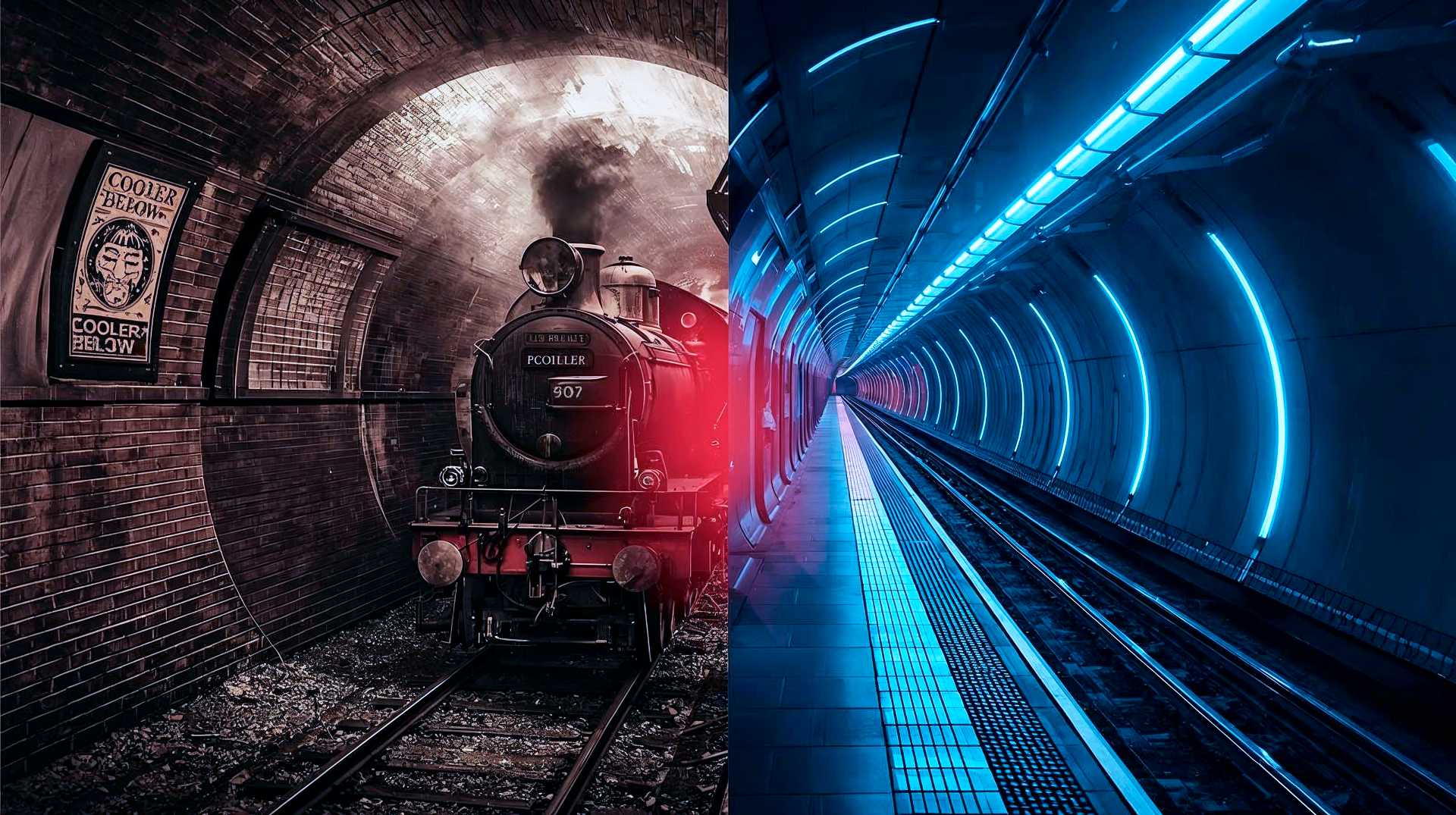
If you’ve ever stepped onto a Bakerloo line train in mid-July, you know the sensation. It is not just heat; it is a heavy, motionless wall of air that smells of ozone, dust, and the collective resignation of three hundred commuters. They call it the “Bakerloo Oven,” and for good reason. In the height of summer, temperatures on the deep lines can push past 30°C, making a journey from Paddington to Waterloo feel less like a commute and more like an endurance sport.
But it wasn’t always this way. In 1906, the Bakerloo line was advertised with posters promising the “Coolest Place in Summer.” The deep tunnels, dug into the thick London clay, were a steady 14°C—a refreshing subterranean refrigerator compared to the sweltering Victorian streets above.
So, what went wrong? How did an engineering marvel designed to be cool turn into a toaster? The answer lies in a complex ecosystem of geology, physics, and history. It is a story of “heat sponges,” invisible pistons, and a clay prison that has slowly, over 120 years, simply run out of room for more heat.
Please note: The content below may contain affiliate links. If you make a purchase through these links, we could earn a commission, at no additional cost to you.
The Science of the Swelter: Why the Clay Failed Us
To understand why the Tube is hot, you have to look at what it is wrapped in. The deep tunnels (like the Northern, Central, Piccadilly, and Bakerloo lines) are bored through London Clay. This dense, grey soil is magnificent for digging tunnels because it keeps its shape and keeps water out.
For the first few decades, the clay was also a magnificent air conditioner. It acted as a giant “heat sink.” Think of the clay like a cold, dry sponge. When hot trains ran through the tunnels, the cold clay absorbed the heat effortlessly, pulling it out of the air and keeping the tunnels at that lovely 14°C.
But here is the problem with sponges: eventually, they get full.
After more than a century of absorbing heat from friction, motors, and millions of warm bodies, the clay surrounding the tunnels has effectively “cooked.” It has reached its thermal capacity. The temperature of the clay around the tunnels has risen from 14°C to roughly 20–25°C. It is no longer a heat sink; it is an insulator. The heat generated today has nowhere to go. It stays in the tunnel, trapped by warm walls that refuse to absorb another degree.
Where Does the Heat Come From?
You might think the heat comes from the lack of fresh air, but it is actually being generated constantly inside the tunnels.
- Braking (38%): The biggest culprit. Traditional train brakes work by friction—pressing pads against wheels. This turns the train’s massive kinetic energy directly into heat. Every time a train slows down for a station or a signal, it blasts the tunnel with hot air.
- Mechanical Systems (22%): The electric motors and gearboxes that drive the wheels are essentially large heaters.
- Passengers (3-7%): A carriage full of commuters is biologically a collection of 100-watt heaters. When you pack 800 people onto a train, you are effectively turning on 800 light bulbs in a small, sealed room.
- Solar Gain: A newer theory suggests that when trains run on surface sections (like the Central line at Epping), they soak up heat from the sun. They then carry this heat into the tunnels, radiating it out like hot bricks.
How the Tube Ventilates: The Invisible Piston
If the walls won’t absorb the heat, you have to move the air out. The London Underground relies on a mix of passive physics and active engineering to breathe.
1. The Piston Effect
The most important ventilation system on the Tube is the train itself. The deep-level tunnels are narrow—only about 3.6 metres wide. The trains are a tight fit, like a plunger in a syringe.
As a train rushes through the tunnel, it pushes a plug of stale, hot air in front of it and sucks fresh, cooler air in behind it. This is the Piston Effect. It is why you feel that sudden, hair-ruining gale on the platform just before the train arrives. It is the network’s natural lung, shoving air up stairways and through ventilation shafts.
2. Draught Relief Shafts
To stop the Piston Effect from blowing passengers over or slamming doors shut, engineers built “Draught Relief Shafts.” These are hidden chimneys scattered across London—sometimes disguised as fake houses or grey boxes in parks—that connect the tunnels to the street. They allow the high-pressure air pushed by the train to escape to the surface, “relieving” the pressure.
3. Mechanical Fans
On top of this, there are huge industrial fans housed in ventilation shafts. These can either suck hot air out or push fresh air in. On the Victoria line, for instance, powerful fans change the air in the tunnels regularly. But on older lines, these shafts are few and far between. You cannot easily dig a new giant chimney in the middle of Oxford Street without knocking down a historic building.
The Deep Tube Dilemma: Why You Can’t Just Use Air Con
“Why don’t they just turn on the air conditioning?” is the most common question grumbled by sweating Londoners.
The answer is simple physics: Air conditioning does not remove heat; it moves it. An AC unit takes heat from inside the carriage and dumps it outside.
- Sub-Surface Lines (District, Circle, Metropolitan, Hammersmith & City): These tunnels were built by the “cut and cover” method—digging a trench and roofing it over. They are rectangular, wide, and close to the surface. There is plenty of space for the heat dumped by AC units to dissipate or vent to the street. That is why the S-Stock trains on these lines have glorious, freezing air conditioning.
- Deep Tube Lines: These are the problem. The tunnels are tiny circular tubes. There is barely inches of clearance around the train. If you put standard AC on a Central line train, it would pump heat out into the narrow tunnel. The tunnel would get hotter. The AC would then suck in that hotter air, try to cool it, and dump even hotter air out. The tunnel temperature would spiral upwards, eventually causing the equipment to fail.
Until recently, putting AC on the deep tube was considered engineeringly impossible.
A History of Hot Air
London Transport has been fighting the heat for a century.
The 1934 Ice Box In 1934, they tried to cool the Northern line. They fitted a carriage with a refrigeration unit and blocked up the windows. It was a disaster. Passengers hated the sensation of being sealed in; they felt claustrophobic and panicked. The experiment was scrapped, and for decades, the solution was simply “open the window at the end of the carriage.”
The Mayor’s Prize In 2003, during a blistering summer, the Mayor of London offered a £100,000 prize to anyone who could solve the Tube cooling problem. It went unclaimed. The constraints—no space, no way to vent heat, ancient infrastructure—defeated the world’s brightest minds.
The Future is Cool (and Clever)
Despite the challenges, the tide is turning. We are now entering a new era of “Cooling the Tube,” driven by brilliant innovations that work with the constraints rather than fighting them.
1. The Bunhill 2 Energy Centre: Trash into Treasure
In Islington, a revolutionary project called Bunhill 2 has turned the problem on its head. Instead of trying to destroy the hot air, they are harvesting it.
A massive fan extracts hot air from a Northern line ventilation shaft. This 25°C air is passed through a heat exchanger (like a radiator in reverse). The heat is captured and used to warm water, which is then pumped into over 1,350 local homes, a school, and two leisure centres.
It is a double win: the Tube gets cooler because the heat is removed, and the community gets cheaper, low-carbon heating. It is the world’s first scheme of its kind, proving that the Tube’s waste heat is actually a valuable resource.
2. The New Piccadilly Line Trains (2025/2026)
The biggest game-changer arrives soon. Siemens has built the “Inspiro London” trains for the Piccadilly line, and they have achieved the impossible: air conditioning on the deep tube.
How? By changing the shape of the train. Old trains have two “bogies” (wheel sets) under every carriage. The Inspiro trains are “articulated”—the carriages are joined permanently, sharing bogies. This means fewer wheels are needed overall.
Fewer wheels mean more empty space underneath the floor. Siemens has packed compact air cooling units into this underfloor space. Crucially, these trains are also lighter and use “regenerative braking” (turning braking energy back into electricity rather than heat), so they generate much less heat in the first place.
3. Groundwater Cooling
At Victoria station, engineers found a way to use London’s cold groundwater. They pump water from deep underground, circulate it through heat-exchange pipes in the station tunnels to soak up the heat, and then pump it back out or into the sewers. It’s essentially using the earth’s blood to cool its veins.
Conclusion
The London Underground is a living, breathing ecosystem. For a hundred years, we treated it as infinite—assuming the clay would absorb our heat forever. We were wrong. The “Bakerloo Oven” is the result of a century of thermal debt.
But we are paying it back. Through genius engineering like the Bunhill energy capture and the articulated Inspiro trains, we are finally managing the temperature. It will never be icy cold—it is, after all, a metal tube full of people buried in the earth—but the days of the 35°C commute are numbered.
Until then, if you are stuck on the Central line in August, remember: you are not just sweating; you are experiencing a geological phenomenon. And always carry a bottle of water.
Further Reading & Sources:
- Transport for London: Cooling the Tube Programme
- Islington Council: Bunhill 2 Energy Centre
- Siemens Mobility: Inspiro London (New Piccadilly Line Trains)
- London Datastore: Rolling Stock Data