

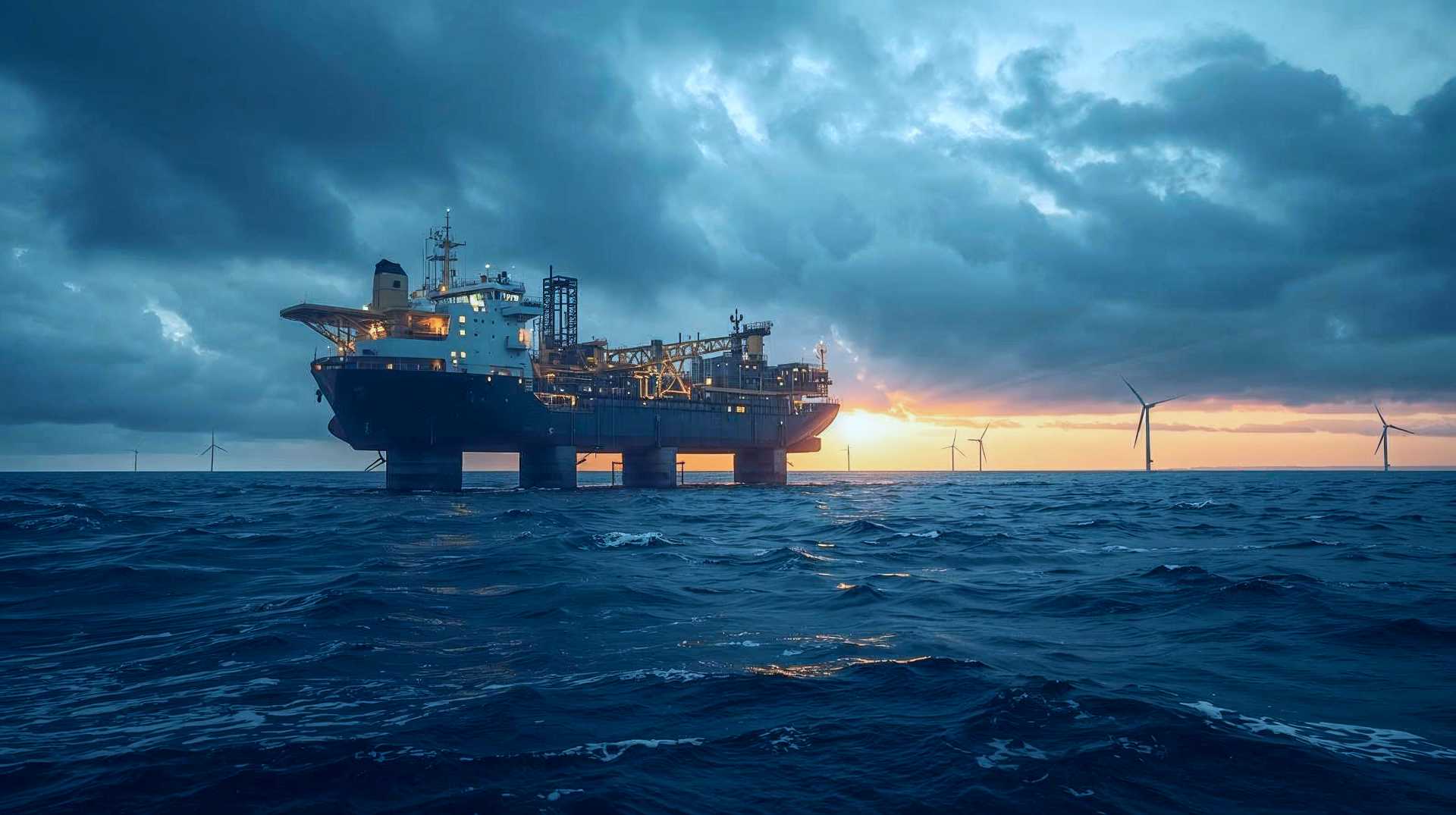
Imagine standing on a metal grate, 100 feet above a raging, grey ocean. The wind is screaming so loud you can’t hear yourself think, and the steel structure beneath your boots—which weighs as much as 40,000 cars—is shuddering slightly as waves the size of houses crash against its legs.
For fifty years, this has been a daily reality for thousands of British workers. They lived and worked on the “Iron Islands,” a sprawling network of oil rigs and platforms scattered across one of the most hostile seas on Earth.
They pulled billions of barrels of “black gold” from beneath the seabed, transforming Britain’s economy and fuelling our cars, homes, and industries. But now, the party is winding down. The wells are drying up, the climate is changing, and the politics have shifted. We are now facing one of the biggest engineering challenges in history: taking it all apart.
This is the story of North Sea oil—how we found it, how we built the impossible to get it, and how we are now dismantling the engineering marvels of the 20th century.
Please note: The content below may contain affiliate links. If you make a purchase through these links, we could earn a commission, at no additional cost to you.
The Great British Gold Rush
Before the 1960s, nobody thought much of the North Sea. It was cold, dangerous, and full of fish. But in 1959, a massive gas field was found in the Netherlands, and geologists began to wonder if the rocks stretched across to the UK.
They were right.
The First Finds
In 1965, BP’s Sea Gem rig struck gas off the coast of Lincolnshire. It was a moment of triumph, tragically cut short when the rig collapsed days later, killing 13 men—a grim reminder from the start that the North Sea demands a heavy price.
But the race was on. By 1969, oil was found in Norwegian waters, and in 1970, BP struck the Forties field, a massive reservoir of oil east of Aberdeen. Shell followed with the Brent field in 1971. Suddenly, Britain wasn’t just an island of coal; we were an oil power.
“It’s Scotland’s Oil”
The discovery changed everything. Aberdeen, a grey granite city famous for fishing and paper mills, transformed overnight into the “Oil Capital of Europe.” Helicopters buzzed overhead, Americans with cowboy hats walked Union Street, and wages soared.
Politically, it was dynamite. In the 1970s, the Scottish National Party (SNP) launched the famous slogan “It’s Scotland’s Oil,” arguing that the wealth flowing from Scottish waters should stay in Scotland. While the cash ultimately flowed to the UK Treasury in London, the debate about who owns that wealth has never really gone away.
The Engineering Marvel: Skyscrapers at Sea
It is hard to overstate just how difficult it is to get oil out of the North Sea. The water is deep, the weather is atrocious, and the oil is miles underground.
To get it, engineers had to invent new worlds. They couldn’t just park a ship there; they needed permanent cities.
Gravity-Based Structures (The Concrete Giants)
Some of the most iconic structures are the Gravity-Based Structures (GBS). Think of the Brent Delta platform. It wasn’t bolted to the seabed; it was just incredibly heavy.
- How they work: Engineers built three massive concrete legs, hollow and thick, sitting on a giant tank. They floated this concrete island out to sea, then flooded the tanks with water until it sank and settled on the bottom.
- The scale: These structures are taller than the Eiffel Tower. The concrete legs are so thick they could withstand a ship crashing into them.
Steel Jackets
Other platforms sit on “jackets”—huge steel trellises pinned to the seabed with metal piles. These look like electricity pylons on steroids. They were built on land, towed out on barges, and tipped into the water.
Saturation Divers
Building these wasn’t just about machines. It relied on saturation divers. These men lived in pressurised chambers on ships for weeks at a time. They would be lowered in diving bells to the dark, freezing seabed to bolt flanges and weld pipes. It was incredibly dangerous, high-paid work that pushed the limits of human physiology.
Life on the Rigs: Bears, Bonds, and Boredom
Life offshore is a strange mix of danger and dull routine. Workers typically do shifts of “two weeks on, three weeks off” (though in the old days, it was often equal time).
- The Commute: You don’t take a train; you take a helicopter. You wear a survival suit (a “babygro” made of thick rubber) and undergo training on how to escape if the chopper ditches in the sea.
- The “Bears”: This is the nickname for roughnecks and rig workers. It’s a tight-knit community. You work 12-hour shifts, day or night.
- The Food: It’s legendary. To keep morale up, oil companies feed their crews incredibly well. Steak, unlimited puddings, and fry-ups are standard. You can put on weight fast if you don’t hit the gym.
- The Golden Rule: No alcohol. Rigs are “dry.” One drop of beer and you’re on the next chopper home, fired.
The Night That Changed Everything: Piper Alpha
You cannot talk about North Sea oil without talking about Piper Alpha.
On the night of 6 July 1988, a series of errors led to a massive gas leak on the Piper Alpha platform. The resulting explosion and fire killed 167 men. It remains the world’s deadliest offshore oil disaster.
The tragedy revealed deep flaws. Safety valves had been removed for maintenance, but the night shift didn’t know. The walls weren’t fireproof enough. The evacuation systems failed.
The Legacy: The disaster completely changed the law. Before Piper Alpha, the rules were a checklist: “Do you have 5 lifeboats?” After Piper Alpha, the rules became “Goal-Setting.” Now, operators must prove—through a massive document called a Safety Case—that they have identified every risk and reduced it as much as possible. It made the North Sea one of the safest places to work in the global energy industry.
The Dismantling: The Big Clean-Up
Today, the North Sea is changing. Many fields are empty. The equipment is old. And critically, climate change means we are moving away from fossil fuels.
We are now in the Decommissioning phase. This is the engineering equivalent of taking the Great Pyramid of Giza apart, stone by stone, while it’s still underwater.
The Scale of the Job
There are hundreds of platforms and thousands of miles of pipeline to remove.
- Cost: It costs about £2 billion a year just to clean up. The total bill over the next decade is estimated at £27 billion.
- Taxpayer Money: Because of how tax relief works, the British taxpayer is effectively paying for about 40% to 70% of this cleanup bill.
The “Plug and Abandon” (P&A)
The most expensive part isn’t removing the visible rig; it’s sealing the well. Imagine a straw going miles down into the earth. You can’t just pull it out, or oil might leak forever.
- Cleaning: They scour the pipe to remove gunk.
- Plugging: They pump special cement deep into the well to create a rock-hard seal.
- Cutting: They cut the steel pipe 10 feet below the seabed so nothing is left sticking up for fishing nets to catch on.
The Monster Ship: Pioneering Spirit
In the old days, we had to cut rigs into small pieces to remove them. Now, we have the Pioneering Spirit.
- What is it? It is the largest construction vessel in the world. It looks like two supertankers joined together (a catamaran).
- The Lift: It straddles the oil platform. Giant beams clamp onto the rig. In seconds, it uses hydraulic power to lift the entire top of the platform (the “topsides”)—weighing up to 48,000 tonnes—in one go. It then sails it to Hartlepool or Teesside to be recycled. It’s like a giant hand plucking a daisy.
The Future: From Black Gold to Green Power
As of 2025 and 2026, the political landscape has shifted dramatically. The UK government has introduced a ban on new oil and gas exploration licenses. The message is clear: the era of hunting for new oil is over.
However, the North Sea isn’t dying; it’s transitioning.
- Wind Power: The same winds that battered the oil rigs are now spinning giant turbines. The North Sea is becoming the “battery of Europe.”
- Carbon Capture (CCUS): Remember those empty gas fields? We plan to capture CO2 from factories, pump it back down the old pipes, and store it safely under the seabed. We are putting the carbon back where it came from.
- Repurposing: Some old platforms might not be scrapped. They could be turned into substations for wind farms or hydrogen production plants.
Conclusion
North Sea oil defined a generation. It paid for schools and hospitals, it created the Thatcherite economic boom, and it forged a unique culture of roughnecks and engineers.
We are dismantling these steel giants now. It is a melancholy sight to see them towed into port to be scrapped. But the engineering genius that built them hasn’t gone away. The men and women who learned to conquer the waves for oil are now the same people building the wind farms and carbon stores of the future. The Iron Islands are going, but their legacy remains.
Further Reading:
- North Sea Transition Authority (NSTA) – The official regulator for the industry.
- Offshore Energies UK (OEUK) – The leading trade body providing industry reports and economic data.
- Step Change in Safety – A member-led organisation founded after Piper Alpha to make the UK the safest oil province in the world.