

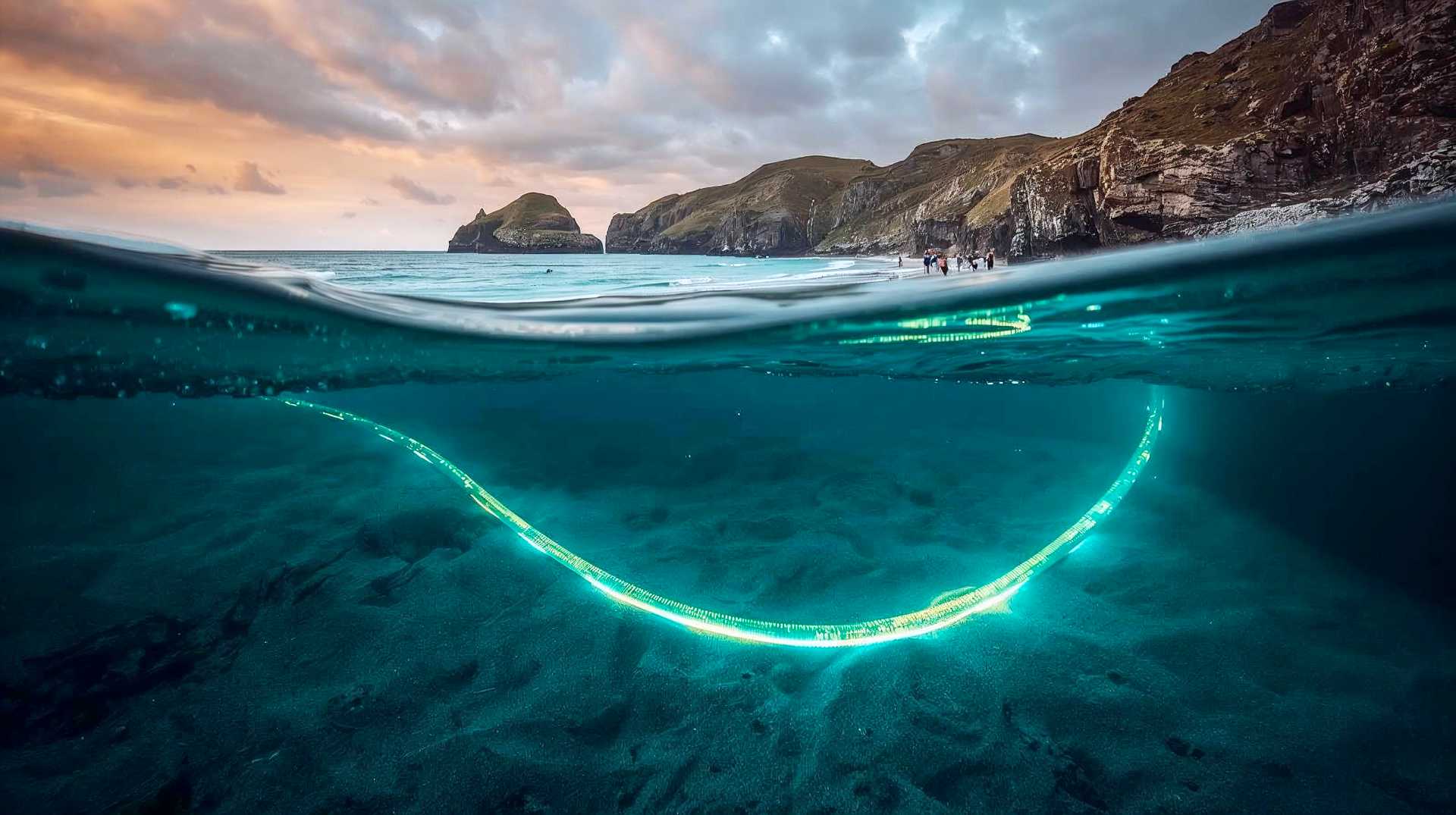
If you were to stand on the golden sands of Porthcurno Beach in West Cornwall on a sunny July afternoon, you would see a quintessential British seaside scene. Families huddled behind windbreaks, brave souls dipping toes into the Atlantic, and the turquoise water lapping against the granite cliffs of the Minack Theatre. It’s a place of dramatic natural beauty, a haven for tourists and locals alike.
But beneath your feet, buried deep in the sand and stretching out into the dark, cold depths of the ocean, lies something far more critical than holiday memories.
You’re standing on top of the internet.
Cornwall is often thought of as a place of pasties, tin mines, and Poldark, but in the world of telecommunications, it’s a global superpower. For over 150 years, this rugged peninsula has been the physical ear and mouth of Great Britain, the point where the UK connects to the rest of the world. Today, roughly 25% of the world’s internet traffic between Europe and the USA passes through Cornwall.
This is the story of the “Dark Fibre”—the massive, hidden network of cables that keeps our digital lives running, and the remarkable Cornish history that made it all possible.
Please note: The content below may contain affiliate links. If you make a purchase through these links, we could earn a commission, at no additional cost to you.
1. The Invisible Highway: Busting the Satellite Myth
Before we dig into the Cornish sand, we need to clear up a common misunderstanding. If you ask most people how the internet works—how a WhatsApp message gets from London to New York, or how you stream a Netflix show hosted on a server in California—they will point to the sky. Satellites.
It makes sense. We see satellite dishes on houses; we use GPS. But when it comes to the internet, satellites are a sideshow. They account for less than 1% of global traffic. They are simply too slow and too expensive for the heavy lifting of the modern web.
The real work is done by submarine cables. These are garden-hose-sized pipes laid directly on the seabed, stretching for thousands of miles across the abyss. Inside them are hair-thin strands of glass—optical fibres—that carry data as pulses of light.
They are the physical internet. And for the UK, the most important doorstep for these cables is Cornwall.
What is “Dark Fibre”?
The term “Dark Fibre” sounds mysterious, perhaps a bit sinister, like the “Dark Web.” In reality, it’s a technical term with a simple meaning.
When a fibre optic cable is laid, it contains many strands of glass. To send data, you shine a laser down them—you “light” the fibre. Dark Fibre refers to the strands that are laid but not yet used. They are “unlit.”
Companies lay extra strands because the most expensive part of the job isn’t the cable itself, but the ship and the crew needed to lay it. It’s cheaper to lay 100 strands and only use 10 now, keeping 90 “dark” for the future, than to come back and lay a new cable in five years.
However, in the context of Cornwall, “Dark Fibre” has taken on a second, more poetic meaning. It refers to this vast, invisible infrastructure that lies beneath the moors and beaches, unseen and unappreciated, yet silently powering the economy.
2. Why Cornwall? The Geography of Connection
Why did this remote Celtic county become the hub of global communications? It wasn’t an accident; it was geography.
If you look at a map, Cornwall thrusts out into the Atlantic Ocean like a jagged finger. It is the westernmost point of the British mainland. If you want to run a cable from London to New York, you don’t want to drag it all the way through the English Channel, which is shallow, busy with shipping (anchors break cables), and full of tidal currents.
Instead, you run the cable over land to Cornwall, and then jump off the edge. Cornwall offers the shortest underwater route to the Americas and Southern Europe/Africa. It essentially acts as a massive pier for the UK’s digital trade.
Furthermore, the seabed off Cornwall’s coast is relatively sandy and gentle before it plunges into the deep ocean, which is perfect for burying cables safely.
3. Porthcurno: The Victorian Internet
To understand the modern fibre optic networks in Bude, we must first look south to Porthcurno. This tiny valley is the spiritual home of global telecommunications.
The Empire’s Ear
In 1870, the world was shrinking. The Victorian era was in full swing, and the British Empire needed to talk to its colonies. Sending a letter to India took six weeks. That wasn’t fast enough for trade or governance.
Enter John Pender, a Scottish textile merchant with a vision. He formed a company (which would eventually become Cable & Wireless) to lay a telegraph cable from the UK to India. On a summer’s day in June 1870, the cable ship Investigator landed the shore end of the cable at Porthcurno.
Suddenly, a message to Bombay didn’t take six weeks. It took nine minutes.
The ‘PK’ Bunker
Porthcurno, codenamed ‘PK’, became the most important telegraph station on Earth. At its peak, it was the busiest station in the world. It was so vital that during World War II, the entire operation was moved underground into bomb-proof tunnels blasted into the granite cliffs.
The Nazis knew about Porthcurno. They knew that if they cut the cables there, they would deafen the British Empire. Yet, despite being a prime target, the station survived. The tunnels, now the PK Porthcurno Museum of Global Communications, are a time capsule of clacking telegraph keys and 1940s engineering.
For a century, Porthcurno was the hub. But as technology shifted from copper telegraph wires to coaxial telephone cables, and finally to fibre optics, the geography of the network shifted slightly north.
4. Bude: The Modern Digital Fortress
While Porthcurno holds the history, the town of Bude in North Cornwall holds the power.
If Porthcurno is the grandfather, Bude is the high-tech grandson running a start-up. Bude is the landing point for some of the most critical internet cables in existence today. The cables land at Widemouth Bay and other nearby coves, buried deep under the sand where surfers catch waves, running up into nondescript buildings that serve as landing stations.
The Big Cables
Several legendary cables terminate here. Let’s look at a few of the titans:
- Apollo: This is a monster of a system. It consists of two cables, Apollo North (landing in Bude) and Apollo South (landing in France). It connects the UK to New York and is one of the primary bridges for transatlantic data. If you’re trading stocks in London or emailing a colleague in Manhattan, there’s a good chance your data is riding on Apollo.
- Grace Hopper: Named after the pioneering American computer scientist and naval officer (who coined the term “bug” after finding a moth in a computer), this is a Google-funded cable. Landed in Bude in 2021, it was the first new cable to connect the UK and US since 2003. It features 16 fibre pairs—a massive upgrade in capacity—allowing for the streaming of millions of 4K videos simultaneously.
- Amitié: Landed in 2022/2023, this cable connects Bude to Massachusetts and France. It’s part of the new wave of “content provider” cables, funded by tech giants like Microsoft and Meta (Facebook) to ensure their massive cloud services never go offline.
The GCHQ Connection
You cannot talk about Bude’s cables without mentioning the elephant in the room—or rather, the giant satellite dishes on the cliff.
Just a few miles north of Bude, in the parish of Morwenstow, sits GCHQ Bude (formerly CSOS Morwenstow). It is a government signals intelligence establishment. While the specifics of their operations are classified, it is widely documented and reported in the British press (including investigations by The Guardian and Channel 4) that the location is no coincidence.
Being situated right next to the landing points of the transatlantic cables offers a strategic advantage for monitoring communications for national security. While the cables themselves are owned by private consortiums (like Vodafone, Google, and Tata), the proximity of the intelligence services underscores just how vital this physical infrastructure is to the UK’s safety.
5. Goonhilly: The Eye on the Sky
While we’ve established that cables carry 99% of our data, we can’t ignore the Lizard Peninsula. Here, rising from the flat heathland like something from a sci-fi movie, stands Goonhilly Earth Station.
Famous for “Arthur” (Aerial 1), the massive 25.9-metre dish that beamed the Moon landings to British TVs in 1969, Goonhilly is the world’s most famous satellite station.
For a while, as fibre optics took over, Goonhilly seemed in danger of becoming a relic. Why use a satellite for a phone call when a cable is clearer and faster with no delay?
But Goonhilly has reinvented itself. It is now a privately owned “Space Gateway.” It handles deep space communications (talking to missions on Mars), tracks commercial satellites, and serves as a data centre. It complements the cables. If the cables are the heavy freight trains of the internet, Goonhilly is the specialized air freight—handling ships at sea, planes in the air, and data from deep space.
6. How It Actually Works: Light and Sharks
So, how does a cable in Cornwall actually work?
Imagine a hosepipe on the seabed. In the centre are the optical fibres, protected by layers of jelly (to stop water), steel wires (for strength), copper (to carry electricity), and polyethylene (plastic insulation).
The Power Problem
Data travels as light, and light travels incredibly fast. But even in ultra-pure glass, the light eventually gets dim. It fades. To fix this, the cable has “repeaters” every 50 to 100 kilometres. These are cigar-shaped bulges in the cable.
The copper layer carries thousands of volts of electricity from the landing station in Cornwall out to these repeaters. The repeaters boost the light signal, amplifying it so it can travel the next 50km. This happens all the way across the Atlantic.
The Threats
What breaks the internet?
- Fishing Trawlers: By far the biggest threat. A trawler dragging a heavy net along the seabed can snag a cable and snap it. This happens more often than you’d think.
- Anchors: Ships dropping anchor in the wrong place during storms.
- Sharks: A famous myth. In the 1980s, sharks did bite the first experimental cables (perhaps attracted by the electromagnetic field). Modern cables, however, are shielded. Sharks are no longer a problem, despite what YouTube might tell you.
- Sabotage: In recent years, there has been increased concern about “Dark Ships”—vessels turning off their trackers and loitering near cable routes. The UK government has highlighted the protection of these subsea cables as a top-tier national security priority.
7. The Economic Ripple: Superfast Cornwall
You might assume that because Cornwall is the landing point for all this data, the locals would have amazing internet. For a long time, that wasn’t true. It was like living next to a motorway but having no slip road to get on it. The data rushed through Cornwall, not to it.
That changed with the Superfast Cornwall project.
Recognising the irony, a massive EU and BT-funded project was launched in 2011 to upgrade the county. Because the “backbone” of the internet was already right there, it was easier to tap into it.
Cornwall became a testing ground for high-speed fibre. It went from being a digital backwater to having some of the best connectivity in rural Europe.
- The “Work from Home” Revolution: Long before the pandemic, Cornwall’s fibre network allowed high-level executives, graphic designers, and coders to leave London and move to St Ives or Truro. They could run global businesses from a cottage with a sea view.
- Tech Clusters: Newquay and Falmouth have developed thriving tech sectors (Agri-tech, Marine-tech) that rely on this connectivity.
8. The Future: A Digital Legacy
As we look to the future, Cornwall’s role is only growing. The old copper cables of the Victorian era are long gone, but the demand for data is doubling every two years. We need more “pipes.”
New cables are constantly being planned. The technology is getting smarter—”Smart Cables” are now being designed that can also detect earthquakes and tsunamis by measuring pressure changes on the seabed, turning the internet into a global warning system.
There is also a sustainability movement. The International Cable Protection Committee (ICPC) recently released studies on how to recover and recycle old cables, ensuring that the seabed off Cornwall doesn’t become a graveyard of industrial waste.
Conclusion
Next time you are in Cornwall, enjoy the pasty. Marvel at the Eden Project. Surf the waves at Polzeath. But take a moment to look at the horizon.
Remember that beneath the rolling waves, in the cold and the dark, pulses of light are flashing back and forth, carrying the love letters, the bank transfers, the cat videos, and the Zoom calls of the entire planet. Cornwall is not just a holiday destination; it is the anchor that holds the UK to the digital world. It is the silent, beating heart of our information age.
Further Reading
For those interested in diving deeper into this subject, we recommend the following authoritative resources:
- Submarine Cable Map: An interactive, regularly updated map of all global submarine cables.
- PK Porthcurno: The official website of the Museum of Global Communications in Cornwall.
- International Cable Protection Committee (ICPC): The leading global organisation for the protection and resilience of submarine cables.
- Goonhilly Earth Station: Information on the UK’s historic satellite station and its modern deep-space capabilities.