

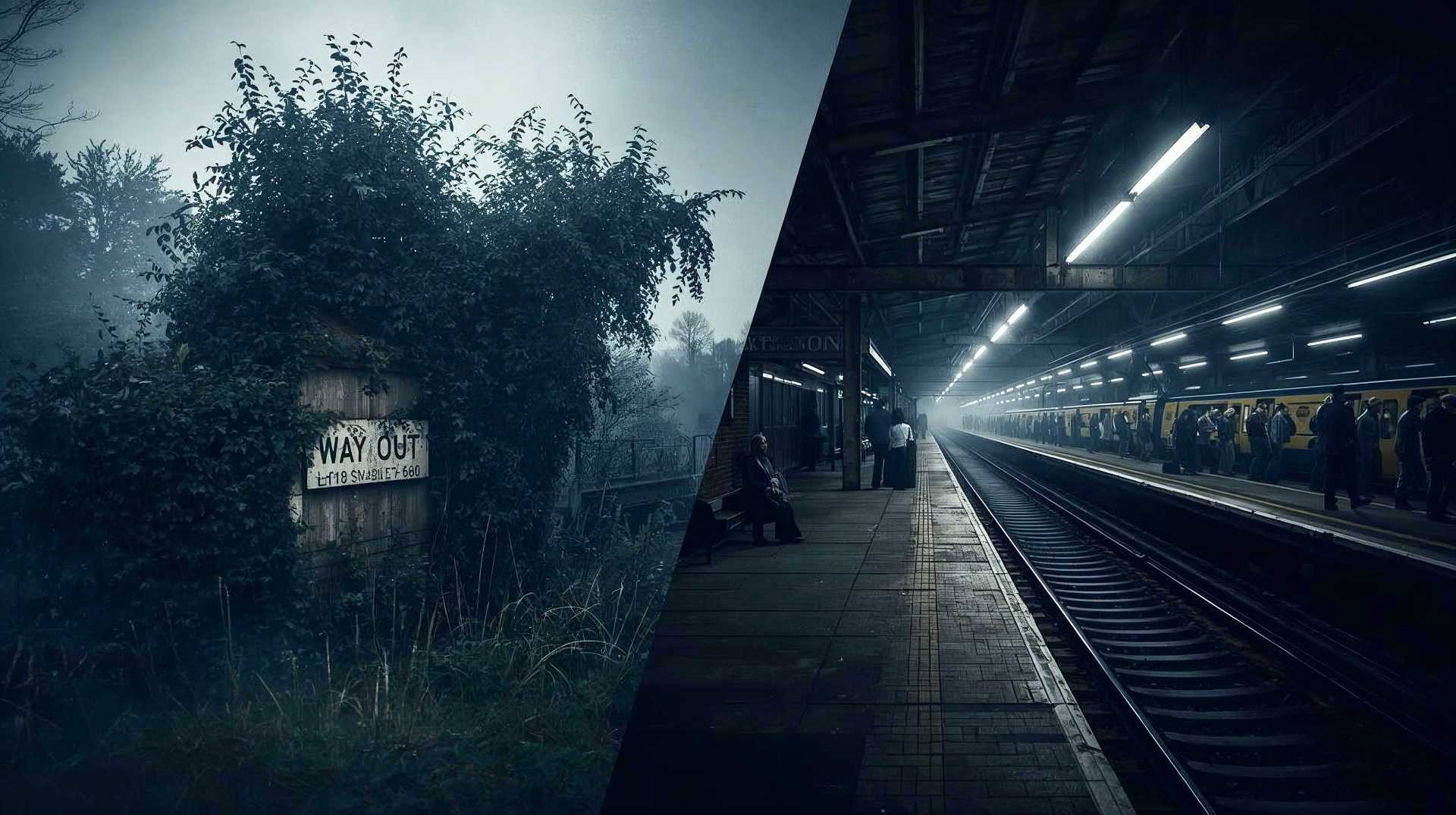
Picture a country lane in the middle of nowhere—perhaps in deepest Devon or the rolling hills of the Scottish Borders. You’re walking the dog, and you come across a strange, flat path cutting through the woods. It’s too straight to be natural. Maybe you find a bridge that crosses over nothing but nettles, or a long, brick platform hidden under fifty years of ivy.
These are the ghosts of the British railway. They are the physical scars left by one man and one report.
The man was Dr. Richard Beeching, and his report, published in 1963, was called The Reshaping of British Railways. To history, though, it’s known simply as “The Beeching Axe.” It was the moment Britain decided that trains were old news and cars were the future. It changed the face of the country forever, cutting off villages, shutting down seaside holidays, and forcing millions of us into our cars.
But six decades later, as we sit in traffic jams on the M6 or squeeze into overcrowded commuter carriages, the question remains: Did the Doctor save the railways by pruning the dead wood, or did he butcher the patient?
Please note: The content below may contain affiliate links. If you make a purchase through these links, we could earn a commission, at no additional cost to you.
Part 1: The Man in the Thick-Rimmed Glasses
To understand the Axe, you have to understand the executioner. Dr. Richard Beeching wasn’t a railwayman. He didn’t grow up dreaming of steam engines or spotting train numbers at the end of a platform. He was a physicist.
Beeching came from Imperial Chemical Industries (ICI), a massive company that made everything from paint to plastics. He was a man of science, logic, and cold, hard numbers. He was famous for his sharp mind and his thick-rimmed glasses, and he looked at the world like a math problem waiting to be solved.
In 1961, the government hired him with a simple, terrifying instruction: Stop the railways from losing money.
The Sick Patient
At the time, British Railways was in serious trouble. It was losing money hand over fist—about £140 million a year. In today’s money, that’s billions. The government was panic-stricken. They saw the railway as a bottomless pit that was swallowing taxpayer cash that could be spent on hospitals or schools.
The problem was that the railway was trying to be everything to everyone. It was running tiny steam trains to remote villages where only three people and a chicken got on board. It was keeping stations open that were built in the Victorian era when the horse and cart was the only competition.
Beeching arrived with his slide rule and his charts. He didn’t care about the romance of the rails. He didn’t care that Mrs. Miggins needed the 10:15 to get to the market. He only cared about one thing: Efficiency.
Part 2: The Bombshell Report
Beeching ordered a survey of the entire network. For one week in April 1961, staff counted every single passenger and every ton of freight. The results were shocking.
He found that:
- One-third of the entire railway network carried just 1% of the passengers.
- Half of the stations brought in less than 2% of the money.
To Beeching, the answer was obvious. If you had a shop that no one visited, you’d close it. He applied the same logic to the trains. On March 27, 1963, he dropped his report on the desk of the Transport Minister, Ernest Marples.
It was a bloodbath.
The Hit List
The report recommended closing:
- 5,000 miles of track (out of 18,000 miles).
- 2,363 stations (more than half of all stations in Britain).
- Tens of thousands of jobs.
The map of Britain was slashed with red lines. Whole regions were to be left without a single train. The plan was to shut down almost everything that wasn’t a main line between a big city. The “Reshaping” wasn’t a trim; it was an amputation.
Part 3: The Great Betrayal? The Politics of the Axe
This is where the story gets a bit murky, and where British people still love a good conspiracy theory.
The Minister of Transport at the time was Ernest Marples. Marples was a flashy, ambitious politician who—crucially—owned a road construction company called Marples Ridgway. He had made his fortune building roads.
Many people at the time (and historians since) have raised an eyebrow at this. Here was the man in charge of transport, whose personal fortune was built on tarmac and concrete, eagerly signing off on a plan to destroy the railways.
Marples was obsessed with motorways. He opened the M1 and saw the car as the symbol of personal freedom and modernity. Trains, to him, were dusty relics of the 19th century. While there’s no proof of direct corruption, the conflict of interest was glaring. It felt to many like the deck was stacked against the train from the start.
The “Bustitution” Failure
To sweeten the pill, Beeching and Marples promised that no one would be left stranded. They invented a new word: “Bustitution.”
The idea was simple: if we close your railway line, we’ll replace it with a bus service. It’ll be cheaper, more flexible, and pick you up closer to your house.
In reality, it was a disaster.
- Buses were slow: A train could cut through a hill; a bus had to go over it, round the winding lanes, and get stuck behind tractors.
- They didn’t connect: The buses rarely waited for the main line trains. If your train was late, the bus was gone, leaving you stranded in the rain.
- They were uncomfortable: Old, rattling buses on potholed roads were no match for the smooth ride of a train.
People voted with their feet. When the trains stopped, people didn’t get on the buses. They bought cars. And if they couldn’t afford a car, they simply stopped travelling. Villages that had been bustling little hubs turned into dormitories or retirement homes. Young people moved away to the cities because they couldn’t get to work.
Part 4: The Survivors and the Lost
The Axe fell swiftly. Between 1963 and 1970, the closures came thick and fast.
The Cultural Wounds
The loss wasn’t just economic; it was cultural.
- The Seaside Special: Families in industrial towns used to take the train to places like Ilfracombe, Padstow, or Mablethorpe for their summer holidays. When the lines closed, those seaside towns withered.
- The Varsity Line: This line connected Oxford and Cambridge, Britain’s two great university cities. Beeching shut it down. Today, driving between them is a nightmare of roundabouts and lorries.
- The Great Central: This was a high-speed, wide-gauge line connecting the North to London. It was built for the future, perfect for modern high-speed trains. Beeching scrapped it. Now, we are spending billions building HS2 (High Speed 2) along a very similar route.
The One That Got Away
It wasn’t all defeats. The most famous survivor is the Settle to Carlisle line. This route cuts through the wildest, most beautiful parts of the Yorkshire Dales and the Pennines. It crosses the Ribblehead Viaduct—a stunning piece of Victorian engineering.
British Rail tried to close it in the 1980s (a delayed aftershock of Beeching). But the public fought back. Tens of thousands of people signed petitions, and even dogs were signed up to protest. The government eventually backed down. Today, it’s one of the busiest and most loved lines in the country, proving that Beeching’s logic of “rural lines don’t pay” wasn’t always right.
Part 5: The Long Shadow
So, here we are in the 2020s. Why does a report from 1963 still matter?
Because we are living in the world Beeching built, and it’s getting cramped.
Beeching predicted that car ownership would keep growing, and he was right. But he didn’t predict that it would stop being fun. He didn’t foresee gridlock, climate change, or the fact that road building destroys the countryside just as much as it connects it.
The Capacity Crunch
Britain’s population has boomed. We have millions more people than we did in the 60s. The remaining railway lines are bursting at the seams. Commuters into London, Manchester, and Birmingham often have to stand for hours because there simply isn’t enough track left to run more trains.
We spent 50 years tearing up the “spare” tracks to sell the land for supermarkets and housing estates. Now, we realise we need them back.
The Environmental Turn
In the 1960s, smoke from a steam engine was seen as pollution. Today, a train is the greenest way to travel. An electric train carrying 500 people takes hundreds of cars off the road. The government is now desperate to get people out of cars to meet climate targets—the exact opposite of the 1960s policy.
Part 6: Turning the Tide
The good news is that the pendulum is swinging back. We are finally starting to reverse the Beeching Axe.
The Borders Railway Miracle
The biggest success story is in Scotland. In 1969, the “Waverley Route” from Edinburgh to the Borders was closed, leaving a huge area without trains. It was a classic Beeching cut.
In 2015, the Scottish government reopened 30 miles of the line, creating the Borders Railway. Experts said it would be a waste of money. They predicted low passenger numbers.
They were wrong. In the first month, 125,000 people used it. It was so popular that passengers were left standing on platforms because the trains were too full. It has revitalized the town of Galashiels, bringing tourists in and allowing locals to work in Edinburgh without having to drive.
The “Restoring Your Railway” Fund
Inspired by the Borders success, the UK government launched a fund to look at reopening other lines.
- ** The Dartmoor Line:** Reopened in 2021, connecting Exeter to Okehampton. It was restored in record time and under budget.
- ** East West Rail:** This is the big one—rebuilding the Varsity Line between Oxford and Cambridge. It’s costing billions, which makes people weep when they realise we already had this line and destroyed it for pennies in the 60s.
- ** The Northumberland Line:** Bringing passenger trains back to towns like Ashington and Blyth, which have been cut off for decades.
Conclusion: Was He a Villain?
It is easy to paint Dr. Beeching as the pantomime villain—the heartless suit who hated trains. But that’s not entirely fair.
In 1963, the railways were a mess. They were using 19th-century technology to fight a 20th-century battle. If Beeching hadn’t cut the dead wood, the whole tree might have died. He saved the main lines that are the backbone of the country today.
However, he made a fatal mistake. He looked at the railway as a business, not a service. A library doesn’t make a profit, but we don’t close it, because it makes the community richer. A rural train line might lose money, but it keeps a village alive, keeps cars off the road, and connects people to the world.
Beeching knew the price of everything, but the value of nothing. And half a century later, Britain is still trying to buy back what he sold.
Further Reading & Resources
If you’ve been bitten by the railway bug and want to dig deeper into the history, the cuts, and the fight to bring trains back, these are the best places to look:
- The National Railway Museum: Located in York, this is the cathedral of British rail history. Their archives hold the original Beeching reports and thousands of photos of the lost lines.
- Campaign for Better Transport: The leading charity fighting for sustainable transport. They are heavily involved in the “Restoring Your Railway” projects.
- RailMapOnline: An incredible interactive map that shows you every single historic railway line in the UK. You can see exactly where the “ghost lines” run near your house.
- Disused Stations: A dedicated database with photos and histories of thousands of stations closed by the Axe. A haunting and fascinating archive.
- Network Rail – The History: The official history from the people who run the tracks today, offering a balanced view on why the modernisation was attempted.