

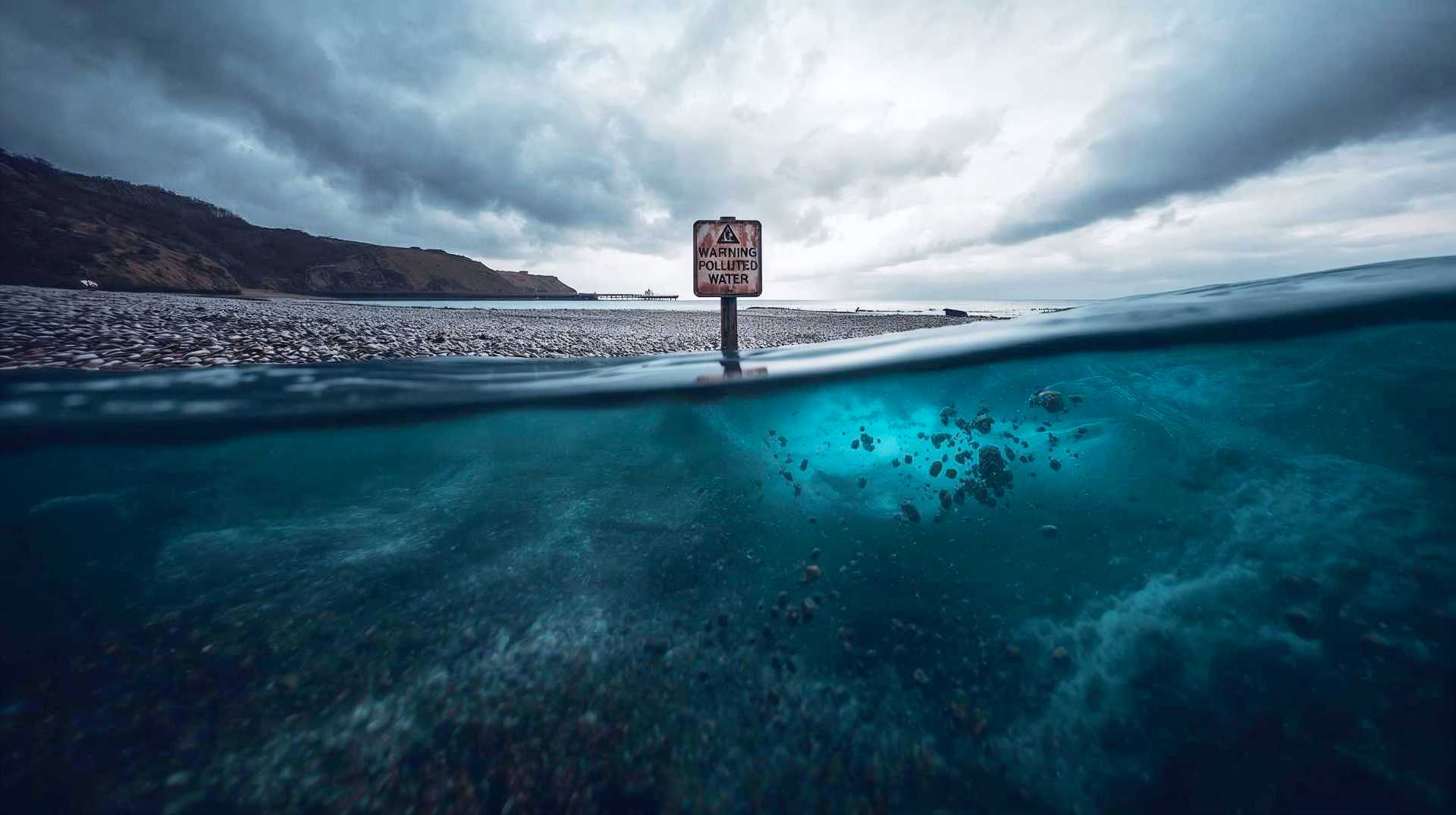
Imagine the quintessential British summer. You’re down in Cornwall or perhaps on the pebbles at Brighton. The sun is fighting a valiant battle through the clouds, the chips are vinegary, and the sea looks inviting. You wade in, bracing for the cold, ready for a refreshing dip. But then you see it. A brown slick. A sanitary towel floating past. The unmistakable smell of something that should have been flushed away and forgotten.
For an island nation defined by its coastline, this is a national humiliation.
In recent years, the state of Britain’s rivers and seas has moved from a niche environmental concern to a front-page scandal. We are swimming in a crisis. But how did we get here? Why, in the 21st century, is one of the world’s wealthiest nations routinely dumping raw human waste into its own backyard?
This is not just a story about dirty water. It is a story of Victorian engineering meeting modern greed, of regulatory failure, complex financial engineering, and a public that has finally said: “Enough.”
This is a forensic audit of the sewage crisis—a deep dive into what is happening beneath our feet and in our waters.
Please note: The content below may contain affiliate links. If you make a purchase through these links, we could earn a commission, at no additional cost to you.
1. The Victorian Legacy: An Engineering Marvel Overwhelmed
To understand why our sewers are bursting, we have to travel back to the summer of 1858. This was the year of the “Great Stink.” The River Thames, essentially an open sewer for a booming industrial population, smelled so bad that MPs in the Houses of Parliament had to soak their curtains in chloride of lime just to continue debating.
The Bazalgette Blueprint
Enter Sir Joseph Bazalgette, the civil engineer who saved London. His solution was monumental: a network of intercepting sewers running parallel to the river, designed to capture waste and whisk it away to East London (and eventually the sea). It was a masterpiece of brickwork and gravity that is still the backbone of the capital’s sanitation today.
But Bazalgette designed his system for a city of roughly four million people. London now holds nine million. Furthermore, he designed a Combined Sewer System.
The “Combined” Flaw
In a combined system, the same pipe carries two things:
- Foul water: The stuff from your toilet, shower, and washing machine.
- Surface water: Rainwater running off roofs, roads, and pavements.
Most of the time, this mixture flows happily to a sewage treatment works to be cleaned. But Bazalgette knew that if it rained too hard, the pipes would fill up. If there were no escape route, the sewage would back up into people’s toilets and flood their homes.
His solution was the Combined Sewer Overflow (CSO). These are essentially safety valves. When the pipes are full, they are designed to overflow automatically into the nearest river or sea.
In the 19th century, this happened rarely—perhaps once or twice a year during a catastrophic storm. The dilution from the rain meant the environmental impact was considered negligible. Today, however, we have concreted over our green spaces (which used to soak up rain), our population has exploded, and the climate is changing. The result? These “emergency” safety valves are now opening with alarming regularity—sometimes even when it hasn’t rained at all.
2. The Privatisation Experiment: 1989 and the Sale of the Century
If Victorian engineering provided the hardware, the politics of the 1980s provided the software that is now crashing.
Before 1989, water was a public service. It was run by regional water authorities. It wasn’t perfect—investment was often subject to government spending cuts—but every penny paid in bills went back into the system.
Thatcher’s Vision
Margaret Thatcher’s Conservative government argued that the private sector would be more efficient. They believed that private companies could raise money on the international markets to fund the massive investment needed to upgrade Britain’s crumbling infrastructure—money the state supposedly didn’t have.
In 1989, the water authorities were sold off. England and Wales became unique in the world: the only countries to fully privatise their entire water and sewerage system. (Scotland kept theirs public, which offers a fascinating comparison we will touch on later).
The Debt-Drift
The promise was that privatisation would unleash a wave of investment. And to be fair, billions have been invested since 1989. However, critics argue that the financial engineering has been just as creative as the civil engineering.
Here is the “forensic” part of the audit. Since privatisation, many water companies have been accused of a practice known as financial extraction.
- Loading up on Debt: When the companies were sold, they had zero debt. Today, the industry carries a debt mountain of over £60 billion. You might assume this debt was taken on to build new pipes. Much of it was. But a significant portion was used to pay…
- The Dividend Bonanza: Since 1989, water companies have paid out roughly £72 billion in dividends to shareholders.
- High Interest Rates: Servicing this massive debt costs money. A chunk of your monthly water bill isn’t paying for clean water; it’s paying the interest on loans taken out to pay shareholders who may have already exited the business.
This model worked well for investors (often pension funds, private equity firms, and sovereign wealth funds from Australia, Canada, or China) when interest rates were low. But now, with infrastructure crumbling and public anger rising, the model is breaking. The collapse of confidence in Thames Water in 2024/25 highlighted just how fragile these financial structures have become.
3. Anatomy of a Spill: The Data Explosion
For decades, the water companies marked their own homework. We didn’t really know how much sewage was being dumped because nobody was counting.
The Monitoring Revolution
Around 2016, a push began to install Event Duration Monitors (EDMs) on these overflow valves. The rollout took years, but by the end of 2023, effectively 100% of storm overflows in England were monitored.
The data that came back was shocking.
In 2023 alone, raw sewage was discharged for over 3.6 million hours into rivers and seas in England. In 2024, reports indicated this high level persisted, with nearly half a million individual spill events.
To visualise this: imagine a tap running at full blast. Now imagine that tap is the size of a tunnel, and the water is brown, carrying wet wipes, condoms, and bacteria. Now imagine that tap running continuously for 400 years. That is roughly the volume of time sewage poured into our waterways in a single year.
The “Dry Spills” Scandal
Perhaps the most damning revelation has been the existence of “dry spills.” Remember, CSOs are legally only supposed to function during “exceptional” rainfall.
However, investigative journalism and data analysis have revealed hundreds of instances where sewage was dumped on bone-dry days. This suggests that the system isn’t just overflowing because of rain; it’s overflowing because the treatment plants simply can’t cope with the daily volume of sewage produced by the population. This is illegal. It is a breach of permit. And yet, it has happened repeatedly.
4. The Human and Ecological Cost
So, what happens when this cocktail enters the water?
The “Sick Soup”
Sewage is not just water and human waste. It is a chemical cocktail. It contains:
- Pathogens: E. coli, intestinal enterococci, and viruses like Hepatitis A.
- Phosphates and Nitrates: From urine and dishwasher detergents. These act as fertilisers, causing massive algal blooms that suck the oxygen out of the water, suffocating fish.
- Microplastics: From synthetic clothes washed in our machines.
- Chemicals: Pharmaceuticals (whatever drugs we take pass through us), road runoff (oil, tyre rubber), and industrial waste.
Public Health Roulette
The impact on human health is immediate and nasty. Surfers Against Sewage (SAS), a charity that has led the charge on this issue, releases an annual water quality report. In their 2024/25 data, they collated nearly 2,000 reports of sickness from people who had been in the water.
We are talking about gastroenteritis (stomach bugs), ear, nose, and throat infections, and even more serious conditions like kidney failure from E. coli.
It’s not just swimmers. Think of the dog walkers whose pets jump in the river. Think of the rowers on the Thames. Think of the anglers.
The Death of the High Street?
The economic impact is also severe. Coastal towns rely on their “Blue Flag” status to attract tourists. When a “Do Not Swim” warning is issued in the height of August, cafes lose trade, ice cream vans sit idle, and hotels see cancellations.
The UK’s shellfish industry is also on the front line. Oysters and mussels are filter feeders—they suck up whatever is in the water. If the water is full of sewage, the oysters become toxic. Fisheries in places like Whitstable have had to close for weeks at a time, devastating local businesses.
5. The Regulator: Watchdog or Lapdog?
If this is illegal, where are the police?
The water industry is regulated by three main bodies:
- Defra (Department for Environment, Food & Rural Affairs): Sets the overall policy.
- The Environment Agency (EA): Responsible for policing pollution and protecting rivers.
- Ofwat (The Water Services Regulation Authority): The economic regulator, responsible for setting the price limits on bills and ensuring companies can finance their functions.
The Failure of Enforcement
For years, the Environment Agency (EA) has been accused of being missing in action. Government funding for the EA was slashed by over 50% between 2009 and 2019. This meant fewer inspectors on the ground and fewer prosecutions. They essentially had to rely on the water companies to self-report their own crimes.
The Ofwat Paradox
Ofwat has faced perhaps the fiercest criticism. Their job is to keep bills low for customers while ensuring companies invest. Critics argue Ofwat prioritised low bills and stable returns for investors over the massive infrastructure spending that was actually needed. They allowed the debt-loading and dividend payouts to happen under their noses.
The “Revolving Door” is a common complaint—the idea that senior staff move effortlessly between the water companies and the regulator, creating a cosy culture where nobody wants to rock the boat.
However, the mood has shifted. In recent years, the EA and Ofwat have launched major criminal investigations. Fines have reached record levels (Southern Water was fined a record £90 million in 2021 for deliberately dumping sewage). But for a company making hundreds of millions in profit, campaigners argue these fines are merely “the cost of doing business.”
6. Turning the Tide: Solutions and Future
Is it all doom and gloom? Not entirely. The public outcry—led by campaigners like Feargal Sharkey (the former pop star turned river crusader) and groups like Windrush Against Sewage Pollution—has forced the government and industry to act.
The Concrete Solution: The Super Sewer
In London, the Thames Tideway Tunnel is nearing completion. This is a £4.5 billion engineering beast—a 25km tunnel running beneath the Thames. It will act as a massive interceptor, capturing the overflow from Bazalgette’s old sewers before it hits the river. It is expected to reduce sewage discharges into the Thames by 95%. It is a stunning feat of engineering, but it only solves the problem for London.
The Green Solution: Nature-Based Approaches
We cannot build a £4.5 billion tunnel for every town in Britain. The disruption and cost would be astronomical.
The alternative is “SuDS” (Sustainable Drainage Systems). This involves un-paving our cities. It means creating wetlands, rain gardens, and permeable pavements that allow rainwater to soak into the ground rather than rushing instantly into the sewers. If we can keep the rain out of the pipes, the pipes won’t overflow.
The Political Solution: Renationalisation?
The debate over ownership has reignited. Polls consistently show a majority of the British public supports bringing water back into public ownership.
The Argument For: It would end the profit motive. Every penny of profit would be reinvested into fixing the pipes. It works in Scotland (Scottish Water is publicly owned and generally sees higher trust levels, though it faces similar physical challenges with infrastructure).
The Argument Against: It would be incredibly expensive. The state would have to buy out the shareholders (potentially costing tens of billions) and take on the sector’s £60 billion debt. That is money that could be spent on the NHS or schools.
The Middle Ground
The current trajectory seems to be tighter regulation rather than total nationalisation. The Environment Act 2021 placed new legal duties on water companies to reduce discharges. The government’s Storm Overflows Discharge Reduction Plan sets targets for eliminating spills—though critics say the 2050 deadline is far too slow.
Conclusion: The Great Clean-Up
The story of British sewage is a warning. It is a warning about what happens when critical infrastructure is treated as a financial asset rather than a public service. It is a warning about the long-term costs of short-term thinking.
We are currently paying for the neglect of the last 30 years. Bills are set to rise significantly between 2025 and 2030 to fund a massive programme of pipe replacement and reservoir building.
But there is a silver lining. We are no longer ignoring the problem. The monitors are on. The data is public. The anger is palpable. The era of the “secret spill” is over. The challenge now is whether we have the political will, and the financial stomach, to pay for the clean-up.
Until then, if you are heading to the seaside this summer, check the app. And maybe keep your head above water.
Glossary of Key Terms
- CSO (Combined Sewer Overflow): The release valve that dumps sewage into rivers when it rains.
- EDM (Event Duration Monitor): The sensor that tells us when a CSO is spilling.
- Ofwat: The economic regulator for the water industry.
- Runoff: Rainwater that flows off hard surfaces (roads, roofs) into drains.
- Grey Water: Wastewater from sinks, showers, and washing machines (as opposed to “black water” from toilets).
Further Reading & Resources
- Surfers Against Sewage (SAS): Check their “Safer Seas & Rivers Service” app for real-time pollution alerts. www.sas.org.uk
- The Rivers Trust: Excellent maps and data on the health of UK rivers. www.theriverstrust.org
- Ofwat: Read the official reports on company performance and fines. www.ofwat.gov.uk
- Environment Agency Data: Access the raw EDM data for every water company. environment.data.gov.uk