

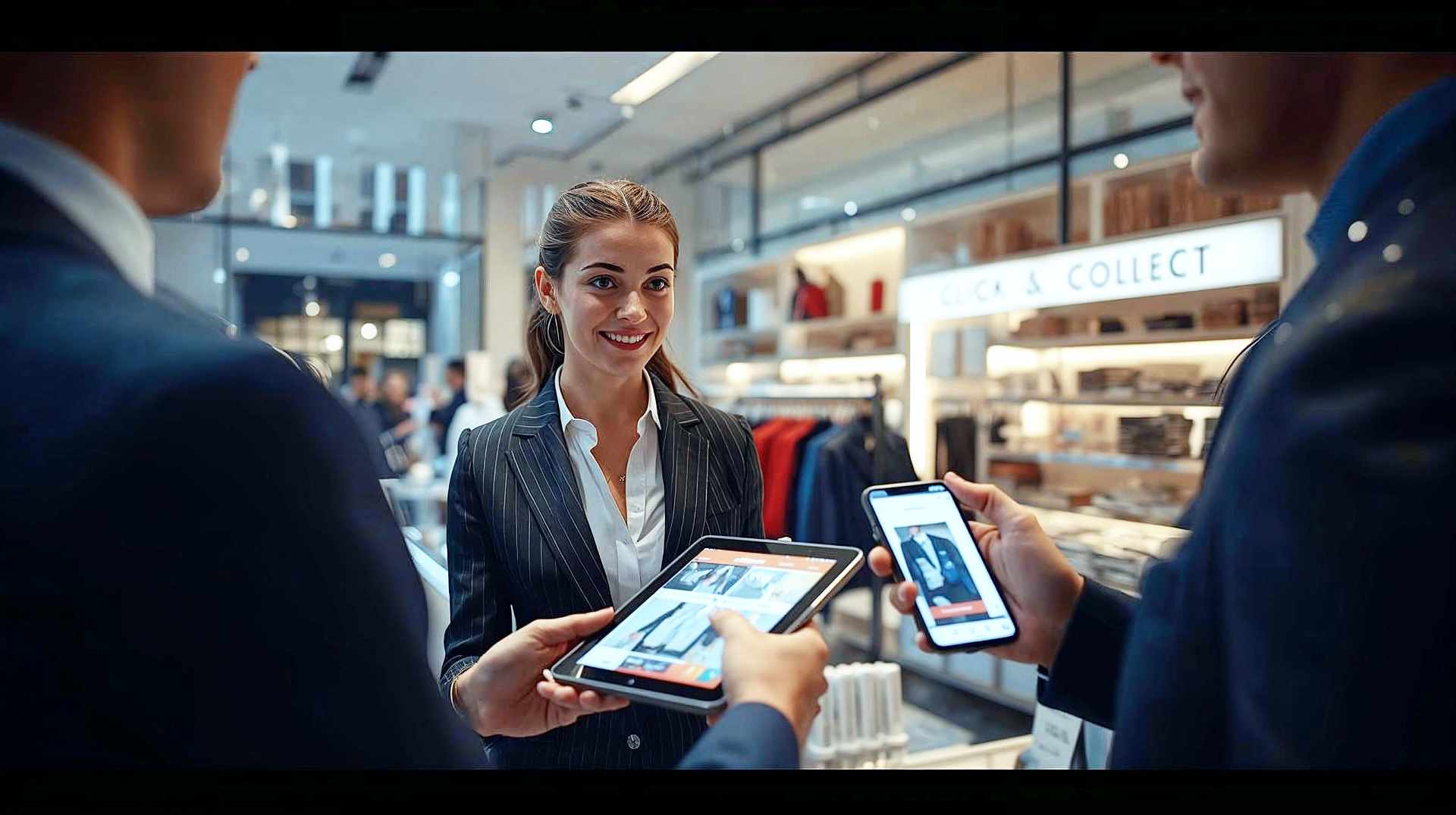
Imagine it’s a drizzly Saturday morning in November. You’re wandering down your local High Street, dodging umbrellas and puddles, on a mission to find a new winter coat. You pop into your favourite shop, spot the perfect coat on the mannequin, but alas, they don’t have your size on the rail.
In the old days, this would be the end of the road. You would trudge home empty-handed, thoroughly fed up. But today, a friendly shop assistant spots you looking lost. They whip out a tablet, tap the screen a few times, and tell you, “We don’t have the medium in stock here, but I can see there’s one in our central warehouse. If you pay now at the till, I can have it delivered to your front door by tomorrow morning.”
You pay, leave the shop feeling chuffed, and jump on the Tube to head home. While you’re underground, you get a text confirming your delivery time. Later that evening, while scrolling through Instagram on your sofa, you see an advert from the same shop suggesting a woolly scarf that perfectly matches your new coat. With one tap, you add it to your order.
That seamless, magical journey from the physical shop floor to your smartphone screen, and finally to your front doorstep? That’s what experts call a brilliant omnichannel customer experience.
If you run a business in the UK today, whether you sell sensible shoes, flat-pack furniture, or artisanal tea, mastering this experience is no longer just a nice bonus. It’s what sets you apart. In this guide, we are going to explore exactly what omnichannel means, how it has transformed the way Britain shops, and, most importantly, provide you with actionable tips to make your customer journey absolutely spot on.
Please note: The content below may contain affiliate links. If you make a purchase through these links, we could earn a commission, at no additional cost to you.
What On Earth Is Omnichannel? Core Concepts Explained
Before we dive into the tips and tricks, we need to clear up some confusing jargon. You might hear the words “multichannel” and “omnichannel” tossed around as if they mean the same thing. They definitely do not.
Multichannel vs. Omnichannel: What is the Difference?
To understand the difference, let’s use a simple analogy.
Multichannel is like a choir where everyone is singing a completely different song. A multichannel business might have a physical shop in Manchester, an online website, and a Facebook page. However, these channels do not talk to each other. If you buy a jumper on their website, the staff in the Manchester shop have no idea who you are or what you bought. If you try to return that online purchase to the physical shop, the assistant might shake their head and say, “Sorry mate, you have to post that back to the web team.” It is frustrating, disconnected, and creates a lot of unnecessary faff for the customer.
Omnichannel, on the other hand, is a perfectly tuned orchestra. Every single instrument (or shopping channel) is playing the exact same piece of music. In an omnichannel business, the physical shop, the website, the mobile app, and the social media pages are all linked together by a central brain.
If you put a pair of trainers in your online shopping basket while using your laptop at work, those same trainers will still be in your basket when you open the store’s app on your phone during your bus ride home. If you decide to go to the physical store the next day to try them on, the staff can pull up your profile, see what you have been browsing, and help you find them instantly.
The “Single View of the Customer”
At the heart of any good omnichannel strategy is something called the “Single View of the Customer.” This is exactly what it sounds like. Instead of having five different files for the same person—one for their website visits, one for their in-store purchases, one for their customer service complaints—the business merges all this data into one neat profile.
When you call a helpline, the person answering the phone should already know who you are, what you bought yesterday, and that you sent them a message on WhatsApp an hour ago. It makes the customer feel valued and understood, rather than feeling like a nameless number in a massive system.
A Stroll Down Memory Lane: The History of British Shopping
To truly appreciate how amazing modern omnichannel shopping is, we need to look at how we got here. The British retail landscape has gone through a massive evolution over the last century.
The Golden Age of the High Street and the Catalogue
Go back fifty or sixty years, and shopping was purely a physical activity. The local High Street was the beating heart of the community. You knew the butcher, the baker, and the local greengrocer by name.
Then came the golden era of the department store and the mail-order catalogue. Brands like Littlewoods and, most famously, Argos, changed the game. The Argos catalogue—often lovingly called the “laminated book of dreams”—was an early attempt at giving customers a different way to browse. You could sit at home with a cup of tea, circle the toys or homeware you wanted with a pen, and then go down to the shop to fill out a little paper slip with a tiny blue pen to collect your items. It was revolutionary for its time: browsing at home, buying in-store.
The Dot-Com Boom and the Digital Shift
In the late 1990s and early 2000s, the internet arrived and turned everything upside down. Suddenly, British shoppers didn’t need to leave the house at all. You could buy books from a new company called Amazon, or bid on secondhand oddities on eBay.
At first, traditional British retailers panicked. They scrambled to build websites, but these early sites were clunky and completely separate from their physical shops. You had “the web team” in one office and “the shop floor staff” in another, and never the twain shall meet.
The Smartphone Revolution
The real tipping point happened around 2010 when smartphones became glued to our hands. Suddenly, the internet was not a place you visited by sitting at a bulky desktop computer; it was in your pocket everywhere you went.
Shoppers started doing something called “showrooming.” They would walk into a shop, look at a television, test it out, and then stand right there in the aisle using their smartphone to buy it cheaper from a rival’s website. Retailers realised that keeping their physical shops and online shops separate was a recipe for disaster. They had to merge them. They had to become omnichannel.
How We Shop Now: Cultural and Societal Impacts
Today, the way Brits shop is a fascinating hybrid of old habits and new technology. The traditional High Street has taken a bit of a battering in recent years, but it is far from dead. It is just evolving.
The Rise of the Hybrid Shopper
Modern British shoppers are incredibly demanding. We want the best of both worlds. We want the endless choices and cheap prices of the internet, but we also want the instant gratification and personal touch of walking into a physical shop.
According to recent retail reports looking ahead to 2026, over 80% of UK shoppers regularly use a mix of both online and in-store channels. We might discover a new brand on TikTok, read reviews on our laptops, go to the physical shop to feel the fabric, and then ultimately buy it via a mobile app while waiting for the kettle to boil.
The “Click and Collect” Phenomenon
Nothing sums up the British omnichannel experience quite like “Click and Collect” (also known globally as Buy Online, Pick Up In-Store, or BOPIS). We absolutely love it. Why wait at home all day for a delivery driver who might chuck your parcel over the back fence into a puddle, when you can just grab it from the shop on your way home from work?
However, our expectations are sky-high. If a customer uses Click and Collect, they expect to walk in, show a barcode on their phone, and walk out with their item in sixty seconds flat. If they have to join the back of a massive queue behind people doing their weekly grocery shop, the omnichannel magic instantly vanishes.
The Second-Hand Boom and Sustainability
Another massive cultural shift in the UK is the focus on sustainability. We are becoming much more conscious of our carbon footprint and the waste created by “fast fashion.” This has led to a massive boom in “recommerce”—buying and selling second-hand goods.
Brilliant omnichannel retailers are leaning into this. They are allowing customers to bring old clothes or electronics back into the physical store to be recycled or resold, rewarding them with digital loyalty points that can be spent online. It ties the physical and digital worlds together while doing a good deed for the planet.
The Nuts and Bolts: Technical and Operational Details
Before we get to the fun part of improving your customer experience, we have to look under the bonnet. Building an omnichannel business requires some clever technology. Don’t worry, we will keep the jargon to a minimum.
1. The CRM (Customer Relationship Management) System
Think of the CRM as the digital brain and memory bank of your business. This software stores everything you know about your customers: their names, their email addresses, what they have bought in the past, and every time they have ever complained or asked a question. Popular systems include Salesforce or HubSpot. A good CRM ensures that whether a customer speaks to Gary in the London shop or Sarah on the webchat, both staff members know exactly who the customer is.
2. The POS (Point of Sale) System
The POS is the modern version of a cash register. But today’s tills do a lot more than just hold coins and print paper receipts. A smart, cloud-based POS system talks instantly to your website. If someone buys the last pair of size 10 boots in your Edinburgh shop, the POS tells the website to instantly mark those boots as “Out of Stock” online, so nobody else tries to buy them.
3. Inventory Management Software
This is the system that tracks your physical stuff. It knows exactly how many items are in your warehouse, how many are in transit on a lorry, and how many are sitting on the shelves in your shops. For omnichannel to work, this system must update in real-time. If it is slow, you end up promising a customer an item that simply isn’t there, which is a cardinal sin in retail.
4. Data Privacy and GDPR
Because you are collecting so much information about your customers to make their experience seamless, you have to be incredibly careful. In the UK, we have strict rules called the General Data Protection Regulation (GDPR). In simple terms, this means you must keep customer data locked down tight, you cannot sell it to dodgy third parties, and you must let customers delete their profiles if they ask. Being trustworthy with data is a huge part of a good customer experience.
8 Practical Tips to Improve Your Omnichannel Strategy
Right, let’s get down to business. How do you actually make your omnichannel experience better? Whether you are running a small chain of bakeries or a massive national clothing brand, here are the ultimate tips for British businesses.
Tip 1: Map the Customer Journey (Walk in Their Shoes)
You cannot fix a problem if you don’t know it exists. The very first step is to map out the journey your customers take, from the moment they discover you to the moment they throw the packaging away.
How to do it: Grab a massive piece of paper and some sticky notes. Invent a typical customer—let’s call him Dave from Bristol. Map out Dave’s journey.
Dave sees a Facebook ad for your waterproof tent. (Touchpoint 1)
He clicks the link on his phone and reads the product page. (Touchpoint 2)
He leaves the site, but gets an email reminder the next day. (Touchpoint 3)
He visits your physical camping shop to see the tent set up. (Touchpoint 4)
He buys it in-store. (Touchpoint 5)
He receives a digital receipt and a “How to Pitch Your Tent” video link via text. (Touchpoint 6)
Look for the potholes in Dave’s journey. Did the Facebook link go to a broken page? Did the shop staff know about the online email offer? Finding and smoothing out these bumps is your top priority.
Tip 2: Break Down Internal Silos (Make Your Teams Mates)
One of the biggest hurdles to omnichannel success is internal business politics. Often, the e-commerce team (who run the website) and the retail team (who run the physical shops) see themselves as rivals. They might even have separate sales targets, meaning they fight over who gets the “credit” for a sale.
How to fix it: You need to change the way you reward your staff. If a customer walks into a physical shop, tries on a jacket, but then the shop assistant helps them order it online on an iPad because the right colour is out of stock, that physical shop should still get a share of the credit for that sale.
When your teams stop fighting over the commission and start working together to simply make the customer happy, the entire experience transforms. Everyone needs to row the boat in the same direction.
Tip 3: Nail Your Real-Time Inventory Visibility
There is a uniquely British feeling of disappointment when you check a website, see an item is “In Stock” at your local store, drive 20 minutes through traffic, pay for parking, walk into the shop, and find out the website was lying. It is enough to make a customer swear off your brand forever.
How to fix it: You must invest in technology that links your website’s stock checker to your shop’s tills in real-time. If an item is bought at the till, the website must update within seconds.
Furthermore, be honest with your customers. If stock is running low, display a message on the website saying, “Only 2 left in your local store – call us to reserve!” It manages expectations and stops people from making wasted journeys.
Tip 4: Personalise Like a Pro (Without Being Creepy)
British shoppers appreciate a personal touch, but we are also fiercely private. We like it when a barista remembers our usual coffee order, but we would be terrified if they knew where we went on holiday last week just by looking at our data. The key is finding the sweet spot.
How to do it: Use the data from your CRM to send helpful, relevant recommendations.
Good Personalisation: “Hi Sarah, we see you bought a coffee machine from us last month. Here is a 10% discount on water filters for that exact model.” This is genuinely helpful.
Creepy Personalisation: “Hi Sarah, we tracked your phone’s GPS and saw you walked past our rival’s shop today. Come back to us!” This is completely out of order.
A great UK example of good personalisation is the Boots Advantage Card. They use your past shopping history to load specific, relevant vouchers onto your digital app. If you buy a lot of baby formula, they will send you offers for nappies. It makes the customer feel understood.
Tip 5: Empower Your Frontline Staff with Tech
Your shop floor staff are the face of your business. If a customer comes in armed with information from your website, and your staff know less than the customer, it is embarrassing.
How to fix it: Arm your shop assistants with technology. Give them tablets or smartphones connected to your central system. If a customer asks, “Do you have this dress in blue?”, the assistant shouldn’t have to vanish into the stockroom for ten minutes to rummage through boxes. They should be able to look at their screen, instantly see the stock levels, and if it’s missing, order it directly to the customer’s house right there on the shop floor.
Retailers like Oasis and John Lewis have championed this. Their staff are equipped with iPads, allowing them to take payments anywhere in the store, banishing the traditional queue at the till.
Tip 6: Perfect the “Click and Collect” Experience
As mentioned earlier, Brits love Click and Collect, but we hate the faff associated with it.
How to fix it: Make the collection process blindingly obvious and lightning-fast.
Clear Signage: When a customer walks in, there should be a massive, impossible-to-miss sign pointing to the collection desk.
Dedicated Areas: Never make Click and Collect customers queue up behind people doing a full weekly shop. Have a separate desk or counter just for collections.
Smart Lockers: Consider installing secure lockers near the front of the store. The customer gets a pin code on their phone, punches it into the locker, the door pops open, and they take their parcel without ever having to speak to a human. It is fast, efficient, and brilliant for busy commuters.
Tip 7: Make Returns a Breeze (The Holy Grail of Trust)
Returns are a headache for retailers, but they are a massive part of the customer experience. If a customer buys something online and doesn’t like it, forcing them to print out a label, buy sellotape, and queue up at the local Post Office is a surefire way to annoy them.
How to fix it: Offer completely seamless, cross-channel returns. If someone buys an item on your mobile app, they should be able to walk into any of your physical shops, hand the item to an assistant, show a barcode on their phone, and get their money refunded instantly.
Marks & Spencer (M&S) are brilliant at this. Their clothing returns policy is famously generous and easy to navigate. When customers know that returning an item is hassle-free, they are actually much more likely to take a risk and make a purchase in the first place.
Tip 8: Ask for Feedback, and Actually Listen to It
You can look at spreadsheets and data all day long, but the best way to find out if your omnichannel experience is working is to just ask the people using it.
How to do it: Set up automated triggers to ask for feedback at the right moments.
If someone uses Click and Collect, send them a quick WhatsApp or email an hour later asking, “Was your collection fast and easy today? Tap thumbs up or thumbs down.”
Don’t send massive, 20-page surveys that take half an hour to fill out. Keep it short, punchy, and relevant.
Most importantly, if you spot a trend in the feedback—for example, if a dozen people complain that the Wi-Fi in your Leeds store is blocking your app from loading—fix the problem immediately.
Future Implications: What’s Next for Retail in the UK?
The world of omnichannel retail never stands still. As we look ahead to 2026 and beyond, technology is going to keep blurring the lines between the digital and physical worlds. Here is a sneak peek at what is coming down the track.
1. Artificial Intelligence (AI) That Actually Helps
We have all dealt with incredibly frustrating website chatbots that just go round in circles. But AI is getting much, much smarter. Very soon, AI won’t just be answering basic questions; it will act as a true personal shopping assistant. Imagine chatting to an AI on a brand’s app, saying, “I have a wedding in Cornwall in October, the dress code is smart-casual, and my budget is £150.” The AI will instantly pull together full outfits from across the retailer’s inventory, check what sizes are available in your local store, and book a fitting room for you to try them on.
2. Augmented Reality (AR) Steps Up
Augmented Reality involves laying digital images over the real world using your phone’s camera. We are going to see a huge leap in this technology. If you are buying a new sofa, you will be able to hold your phone up in your living room and see exactly what that specific velvet green sofa looks like against your wallpaper. If you are buying makeup, you can use your selfie camera to see exactly how a shade of lipstick looks on your skin before you click “buy.”
3. The Survival of the High Street Through “Experiences”
As online shopping becomes even more efficient, physical shops have to offer something the internet simply cannot: a memorable experience. The High Street isn’t dying; it is just changing its purpose. Physical shops will become showrooms and social hubs. We are already seeing sports shops with indoor climbing walls and running tracks to test shoes, or makeup stores offering free beauty masterclasses. The goal of the physical shop won’t just be to store cardboard boxes of stock; it will be to immerse the customer in the brand’s universe. You go to the shop to have fun, and you use your phone to get the actual items delivered to your house.
Conclusion
Creating a flawless omnichannel customer experience is not about buying every flashy new piece of technology on the market. It is simply about common sense, empathy, and making your customer’s life easier.
Whether a British shopper is browsing on an iPad while drinking a cup of tea in bed, or marching through the doors of a physical shop on a rainy Tuesday, they expect the business to know who they are, respect their time, and give them a seamless, joined-up journey.
By mapping out their path, breaking down the barriers between your own staff, getting your inventory systems talking to each other, and empowering your frontline workers, you can build an experience that keeps customers coming back time and time again. In a retail world where the competition is only ever a click away, making your customers feel valued at every single touchpoint is the ultimate recipe for success.
So, put yourself in the shoes of Dave from Bristol or Sarah from Leeds, find the faff in your shopping process, and stamp it out. Your customers—and your bottom line—will thank you for it.
Further Reading
To continue expanding your knowledge on omnichannel strategies, customer journeys, and the future of UK retail, we highly recommend exploring these respected resources:
Retail Economics: For deep dives into UK retail data, shifting consumer habits, and the balance between High Street and online shopping.
Smart Insights: A brilliant hub for digital marketing frameworks, offering detailed case studies on how major brands bridge the gap between their digital and physical presence.
The Office for National Statistics (ONS): For the most reliable, unbiased data regarding UK internet sales versus physical retail spending volumes.
Mintel: Renowned for their comprehensive market intelligence reports covering UK consumer trends, click-and-collect statistics, and retail forecasts.