

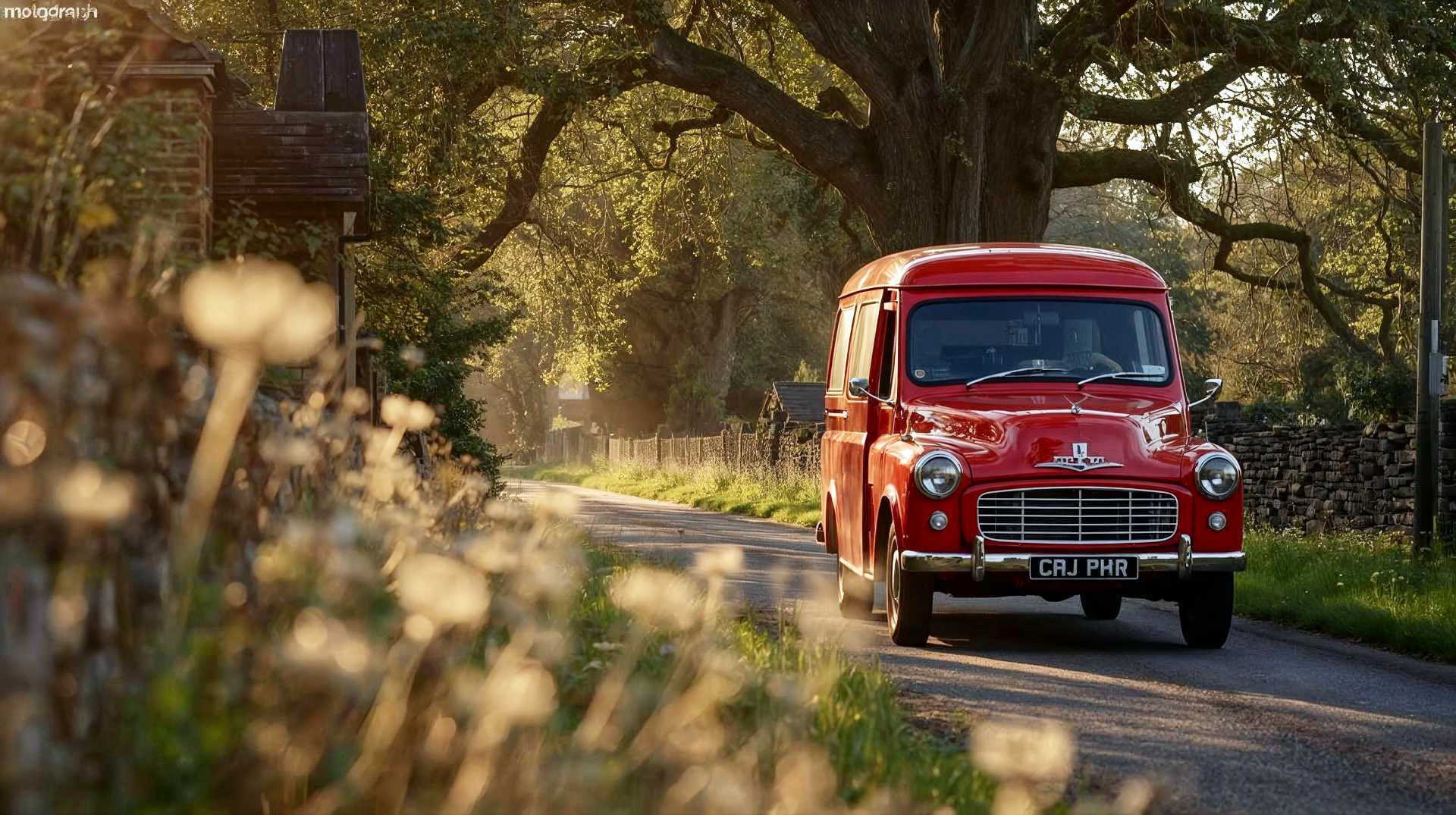
It starts with a splash of red. Perhaps it’s the flash of a van rounding a country lane in Yorkshire, or the stoic, iron silhouette of a pillar box standing guard on a London street corner. For most of us, the Royal Mail is part of the furniture of British life—so familiar we rarely give it a second thought. You drop a birthday card into a slot in Cornwall, and a day or two later, it lands on a doormat in the Scottish Highlands. It feels like magic.
But it isn’t magic. It is a colossal, thumping industrial machine, a logistical ballet performed by 130,000 people, a fleet of 48,000 vehicles, and technology that can read your handwriting faster than you can blink.
This is the story of that machine. It is a story of kings and highwaymen, of sorting robots and electric vans, and of the men and women who walk 10 miles a day, come rain or shine, to keep the nation connected.
Please note: The content below may contain affiliate links. If you make a purchase through these links, we could earn a commission, at no additional cost to you.
The Great Divorce: Clearing the Fog
Before we step onto the sorting floor, we must clear up a national confusion. If you ask the average person on the street, they will likely tell you that the Royal Mail and the Post Office are the same thing.
They used to be. For centuries, they were two arms of the same state-owned body. But in 2012, they filed for divorce.
- The Post Office is the shop. It is the retail network of over 11,500 branches where you buy stamps, renew your passport, and collect your pension. It remains state-owned.
- Royal Mail is the delivery service. They are the ones with the red vans, the sorting centres, and the posties. They were privatised in 2013 and are now a Public Limited Company (PLC), traded on the stock market.
This article is about the latter: the people who pick up the mail, sort it, and bring it to your door.
A History of Connection: From Henry VIII to the Penny Black
To understand the sheer scale of the Royal Mail, you have to look back 500 years.
The King’s Posts
In 1516, King Henry VIII—when he wasn’t busy with his wives—knighted a man named Brian Tuke and made him the first “Master of the Posts.” But this wasn’t a service for you and me. It was strictly for the King’s business. Messengers rode on horseback between royal palaces, changing horses at “posts” along the way. If you were a commoner, you had to find a carrier or a friend travelling in the right direction.
It wasn’t until 1635 that Charles I, strapped for cash, opened the network to the public. It was a chaotic system. The recipient, not the sender, paid for the letter, and the price depended on how far it travelled and how many sheets of paper were inside. It was expensive, complicated, and ripe for reform.
The Victorian Revolution
Enter Rowland Hill. In the late 1830s, this teacher and inventor looked at the postal system and saw a mess. He proposed a radical idea: a uniform rate of one penny for a letter, regardless of distance, paid in advance by the sender.
On May 6, 1840, the Penny Black was issued. It was the world’s first adhesive postage stamp. Suddenly, sending a letter wasn’t a luxury for the rich; it was a tool for the masses. It was the Victorian equivalent of the internet—a democratisation of communication that changed British society forever. Literacy rates soared. Businesses flourished. The modern world was born in a gummed square of paper.
The Journey of a Letter
So, what happens today when you post a letter? Let’s follow a single birthday card, posted in a pillar box in Bristol, destined for an address in Edinburgh.
Step 1: The Collection
Our journey begins at the pillar box. Introduced in 1852 (originally green, but quickly painted red to stop people walking into them), there are now over 115,000 of these boxes across the UK.
Every box has a “timeplate” telling you when the last collection is. A Royal Mail driver arrives, scans a barcode inside the box (to prove they’ve been there), and empties the sack. This isn’t just a casual pickup; it’s a timed military operation. That sack is thrown into the back of a van and driven to a local Delivery Office or straight to a massive Mail Centre.
Step 2: The Mail Centre (The Industrial Heart)
This is where the noise starts. The Mail Centre is a factory of gargantuan proportions. The UK is divided into huge catchment areas, each served by one of these centres—like the famous Mount Pleasant in London or the vast hubs in the Midlands.
When the van arrives, the bags are tipped onto conveyor belts. The first challenge is “culling.” Machines (and humans) sift through the pile to separate the “flats” (large A4 letters), the parcels, and the standard letters.
The Culling and Facing
Standard letters are fed into a machine called a CFC (Culler, Facer, Canceller).
- Cull: It removes items that are too thick or stiff (like a pen inside an envelope).
- Face: It uses sensors to find the stamp. It flips and spins the envelope so the stamp is always in the top right corner.
- Cancel: It prints those wavy lines over the stamp so it can’t be used again.
The Red Glow of the IMP
Next, the letter whizzes into the Integrated Mail Processor (IMP). This is the brain of the operation.
- OCR (Optical Character Recognition): Cameras photograph the address. The computer reads the handwriting—even the scrawly stuff—in a fraction of a second.
- The Code: It converts the address into a bright orange barcode, which is sprayed onto the envelope. You’ve probably seen these faint orange bars on your own post.
Once that orange barcode is on, the machine doesn’t need to “read” the handwriting anymore. It just reads the barcode. The IMP sorts the letter into a tray destined for Edinburgh.
Step 3: The Long Haul
Our Bristol letter is now in a tray with thousands of others heading for Scotland. It’s loaded onto a truck.
Royal Mail’s logistics network is a beast.
- Road: They have huge double-decker trailers that thunder up the M6 and M1 all night long.
- Air: For long distances, like Bristol to Scotland, the mail might fly. Royal Mail uses a hub at East Midlands Airport, where planes swap mail in the dead of night.
- Rail: The days of the dedicated “Travelling Post Office” trains, where men sorted mail on board while steaming through the countryside, ended in 2004. However, mail is still moved in bulk on rail networks today to cut carbon emissions.
Step 4: The Inward Sort
By the early hours of the morning, our letter arrives at the Edinburgh Mail Centre. It goes through another machine, the CSS (Compact Sequence Sorter).
This machine is clever. It doesn’t just sort mail by town; it sorts it by street and even by the postie’s walk. It reads the orange barcode and puts the letter in the exact order the postman will walk down the street. It knows that Number 10 is next to Number 12, but that Number 11 is on the other side of the road and will be delivered later.
Step 5: The Delivery Office (The Local Hub)
Around 6:00 AM, the sorted trays are driven to the local Delivery Office in an Edinburgh suburb. This is where your local postie starts their day.
Inside, there are rows of “frames”—large, red, shelving units with hundreds of slots. Even with the machines doing the heavy lifting, the postie still has to manually sort the “awkward” stuff—magazines, large letters, and parcels—into the frame to match the machine-sequenced letters.
Step 6: The Final Mile
This is the “Last Mile,” the most expensive and difficult part of the journey. A postie loads up their trolley or van.
In the old days, a postie would cycle or walk from the office with a heavy bag over their shoulder. Today, with the rise of online shopping, they are carrying more parcels than letters. They often use a High Capacity Trolley (HCT) or share a van with a partner in a system called “Park and Loop.” They park the van, grab a bundle, loop around a few streets, and return to the van to reload.
Finally, the card drops onto the doormat in Edinburgh. The journey is complete.
The Technology Revolution
We often think of the post as old-fashioned, but it is underpinned by cutting-edge tech.
The Barcode
The introduction of barcodes was a game-changer. It allowed machines to sort mail at speeds of 30,000 items an hour. Modern machines can process nearly a million letters in a shift.
The PDA
Every postie now carries a PDA (a handheld computer). It’s not just for scanning tracked parcels. It tells them about hazards (like a new aggressive dog at Number 4), allows them to take photos of “Safeplace” deliveries, and optimises their route. It’s the digital tether that connects the lonely walker to the central brain of the network.
Automated Parcel Sorting
As letter volumes drop, parcel volumes are exploding. Royal Mail is frantically building giant “Super Hubs” (like the one in Daventry) filled with automated conveyor belts that look like rollercoasters. These hubs can process over a million parcels a day, scanning and routing them without a human hand ever touching them.
The Fleet: Turning Red into Green
The Royal Mail fleet is iconic. There are around 41,500 delivery vans and 6,200 trucks in that famous red livery. But the fleet is changing.
With a massive carbon footprint to tackle, Royal Mail is going electric. They now operate the largest electric delivery fleet in the UK, with thousands of electric vans (EVs) already on the road.
They are also experimenting with “micro-vehicles.” In some cities, you might see posties driving strange little golf-buggy-type contraptions. These are Paxsters or similar electric quadricycles. They are nimble, clean, and can carry more parcels than a trolley but take up less space than a van. There’s even talk of drone deliveries for remote islands in the Orkneys and Hebrides—a sci-fi solution to a centuries-old problem of isolation.
The Human Element: Life as a Postie
Despite the robots and the EVs, the heart of the Royal Mail is still flesh and blood. Being a postie is harder than it looks.
The Fitness
It is not a job for the faint-hearted. A typical postie walks between 10 and 12 miles a day. That’s a half-marathon, five or six days a week. They are statistically some of the fittest workers in the country.
The Elements
There is no “rain day” in the postal service. Whether it’s the blistering heatwave of July or the freezing sleet of February, the USO (Universal Service Obligation) demands the mail gets through. They battle soaked uniforms, frozen fingers, and slippery driveways.
The Hazards
And then there are the dogs. It’s a cliché, but it’s real. Thousands of postal workers are attacked by dogs every year. The PDA warns them, but a loose gate or an open window can turn a routine delivery into a trip to A&E.
The Community
But there is a magic to it, too. For many elderly or isolated people, the postie is the only face they see all day. During the pandemic, they were a lifeline, checking on the vulnerable and keeping communities connected. That trust—the uniform that lets you walk up any garden path in the nation—is the Royal Mail’s most valuable asset.
The Modern Crisis: Letters vs. Parcels
The Royal Mail is currently fighting for its life. The business model that worked for 500 years is breaking.
The Decline of the Letter
We just don’t write anymore. We email, we WhatsApp, we text. Letter volumes have collapsed, falling by nearly half since their peak in the early 2000s. However, the Royal Mail is legally bound by the Universal Service Obligation (USO) to deliver letters to every address in the UK, six days a week, for a fixed price (the cost of a stamp).
Think about that. It costs the same to send a letter from London to London as it does from London to a remote farmhouse in the Shetlands. Delivering to that farmhouse costs the Royal Mail a fortune, but they can’t charge extra.
The Rise of the Parcel
While letters are dying, parcels are booming thanks to Amazon, eBay, and Vinted. But here, Royal Mail has competition. Companies like Evri, DPD, and Amazon Logistics don’t have a USO. They can cherry-pick the profitable city routes and ignore the expensive rural ones. Royal Mail has to do it all.
The Saturday Debate
This has led to a fierce political debate. The regulator, Ofcom, and Royal Mail have suggested cutting Saturday letter deliveries (keeping parcel deliveries 7 days a week) to save money. They argue that nobody needs a bank statement or a bill on a Saturday. But traditionalists and small businesses argue that cutting the service is a slippery slope that devalues the institution.
The Future: A New Coat of Paint?
What does the future hold? The Royal Mail is in a painful transition. It is trying to pivot from a “letters company that delivers parcels” to a “parcels company that delivers letters.”
We will likely see:
- More Automation: Robots doing the sorting, leaving humans to do the walking.
- Parcel Lockers: More “InPost” style lockers where you pick up your own mail, saving the postie the walk to your door.
- Dynamic Routing: Computers changing the postie’s route every day based on where the parcels are, rather than walking the same fixed “round” every day.
Conclusion
The Royal Mail is more than just a logistics company; it is the arteries of the nation. It connects the skyscraper in Canary Wharf to the cottage in the Cotswolds. It has survived civil wars, world wars, and the internet revolution.
While the red pillar box may seem like a relic of a slower age, the machinery behind it is racing to keep up with the modern world. The next time you hear the clatter of the letterbox, spare a thought for the midnight flights, the robotic arms, and the weary legs that brought that envelope to your door. It’s a miracle of organisation, hiding in plain sight.
Further Reading
- The Postal Museum – The definitive resource for postal history, including the Mail Rail.
- Royal Mail Group Sustainability – Details on their “Steps to Zero” and electric fleet initiatives.
- Ofcom Postal Regulation – The official regulator’s reports on the Universal Service Obligation and quality of service.