

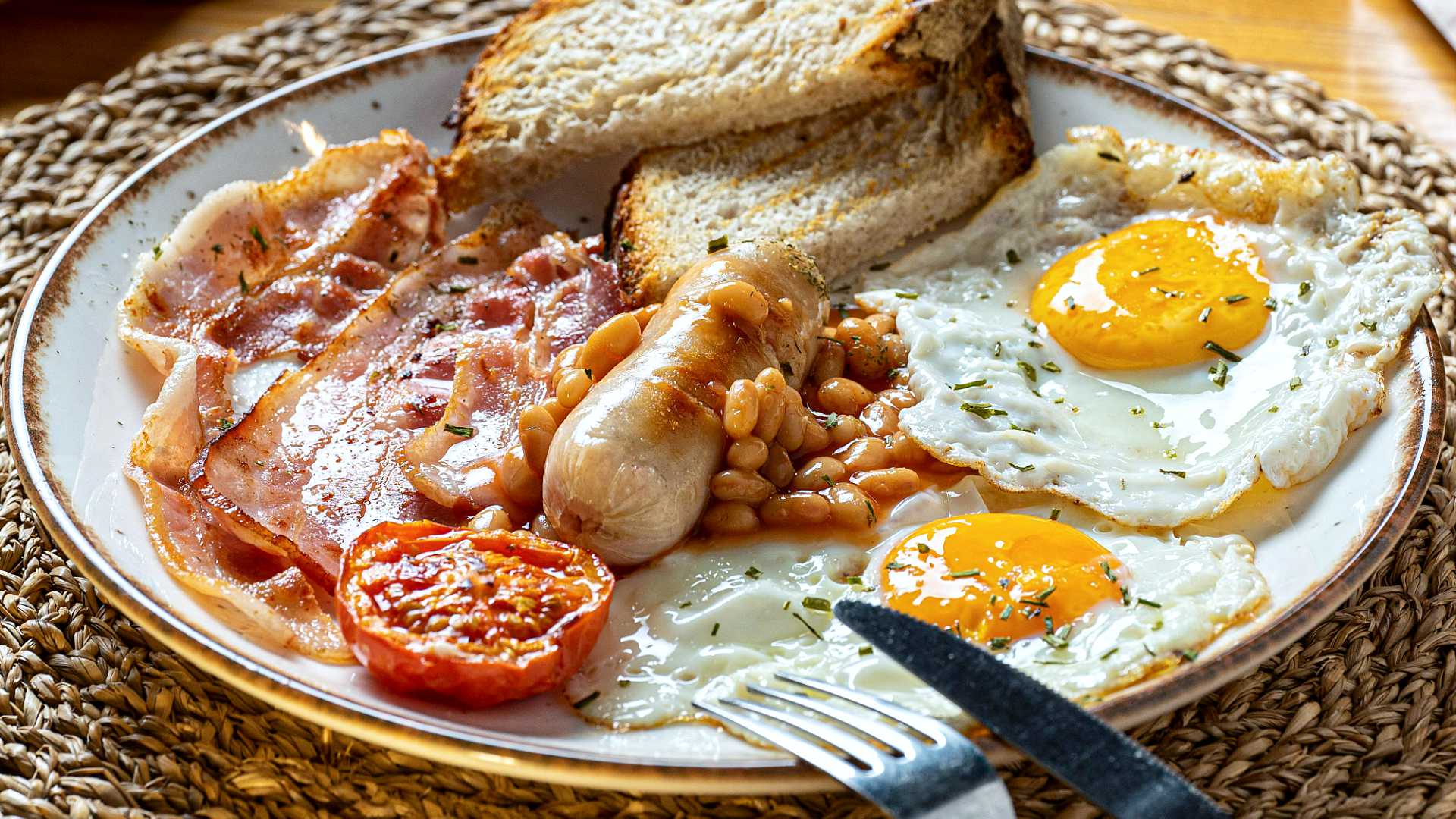
It is the weekend. You walk into your kitchen—or perhaps a local “greasy spoon” cafe with steam running down the windows—and you commit to the national ritual. The Full English Breakfast. It is a plate of food that serves as a hangover cure, a celebration, and a source of fierce national debate (beans or no beans? Chips or hash browns?).
But as you fork a piece of bacon and dip it into a runny egg, you are interacting with a global logistical marvel. That single plate is the finish line of a race involving thousands of miles, hundreds of people, complex trade deals, and precision temperature control.
From the misty wheat fields of East Anglia to the dry plains of North America, and from the intensive heat of a Spanish greenhouse to the blending floors of a tea factory, the supply chain of the Full English is a story of agriculture, engineering, and economics.
Let’s trace the journey of the fry-up, item by item, to understand how the world lands on your plate.
Please note: The content below may contain affiliate links. If you make a purchase through these links, we could earn a commission, at no additional cost to you.
1. The Pig: Bacon and Sausages
We start with the heavy hitters. Without pork, it’s just eggs on toast. The journey of your bacon and sausages is a tale of biology and borders.
The Source: British vs. Imported
If you are buying premium, you might see the “Red Tractor” logo. This means the pork is British, likely raised in counties like Yorkshire or East Anglia. East Anglia is particularly good for outdoor-reared pigs because the soil is sandy and drains well (pigs hate mud as much as they love it; they need dry land to thrive).
However, a huge chunk of the bacon eaten in the UK—especially in cheaper cafes or supermarket “value” ranges—comes from Denmark or the Netherlands. Britain actually imports about 60% of the pork it eats. This is a legacy of trade routes established over a century ago. Danish cooperatives became experts at producing consistent, lean pigs specifically for the British breakfast table.
The Process: Curing and Cold Chains
Once the animal has gone to the abattoir (a process heavily regulated for hygiene), the logistics kick in. Fresh pork spoils fast. To turn pork into bacon, it must be cured.
- Wiltshire Cure: This is the traditional British method where meat is pumped with salts and left to mature. It takes time.
- Industrial Cure: Cheaper bacon is injected with water and chemicals to cure it rapidly. This is why cheap bacon shrinks and releases that white goo in the pan—you’re cooking off the added water.
The Cold Chain: This is the most critical part of food logistics. From the moment the meat is processed, it must be kept below 4°C. Refrigerated lorries (HGV units with big cooling fans on the front) transport the meat to packing centres, then to Regional Distribution Centres (RDCs), and finally to the shop floor. If the temperature spikes at any point, the whole batch is binned.
2. The Eggs: The 24-Hour Race
Eggs are the time-keepers of the supply chain. Unlike bacon, which can be cured and stored, an egg is a ticking clock.
The Laying Hens
Most British eggs come from huge farms housing thousands of birds. The industry has shifted massively in the last decade. “Battery cages” were banned, replaced by “colony cages” (more space) or “free-range” barns. When a hen lays an egg, it rolls onto a conveyor belt immediately. It travels to a packing centre, often on the same site. Here, high-tech machines take photos of every egg, checking for dirt or cracks, and weigh them to decide if they are Medium, Large, or Very Large.
The Lion Mark
You’ll notice a red lion stamp on almost every egg. This is a British success story. In the late 1980s, the egg industry collapsed due to a Salmonella scare. The “British Lion” code was introduced to vaccinate hens and track every single egg.
- Traceability: The code on the egg tells you the farming method (0 for organic, 1 for free-range, etc.), the country of origin, and the specific farm ID. It is a logistical masterpiece of data tracking.
Just-in-Time Delivery
Supermarkets work on “Just-in-Time” (JIT) logistics. They don’t want eggs sitting in a warehouse for weeks. The systems are automated: as soon as you scan a box of eggs at the checkout in Tesco or Sainsbury’s, the computer tells the distribution centre, which tells the farm. A fresh truckload is dispatched often within 24 hours of the egg being laid.
3. The Beans: The Great British Anomaly
Here is a pub quiz fact for you: The “baked bean” is arguably the least British part of the meal, agriculturally speaking.
The Navy Bean
The small white beans used for baked beans are called Navy Beans. They do not grow well in the UK climate—it’s too damp and not hot enough at the right times. Almost every baked bean you eat comes from North America—specifically Michigan in the USA or Ontario in Canada.
The Trans-Atlantic Journey
- Harvest: The beans are harvested dry (they look like little pebbles) in North America.
- Shipping: They are loaded into massive shipping containers and put on freight trains to the coast, then loaded onto gigantic container ships.
- The Wigan Connection: The ships dock in Liverpool. From there, the beans are trucked to factories. The most famous is the Heinz factory in Wigan. It is the largest food processing plant in Europe.
The Canning
Once in Wigan, the dry beans are rehydrated, steamed, and canned with that secret tomato sauce. The logistics here are about scale. The factory produces millions of cans a day. The supply chain is robust because dried beans last for ages. Unlike eggs, beans can sit in a silo for months, acting as a buffer against supply shocks.
4. The Toast: Chemistry and Combines
Bread is the staple, but the slice on your plate is likely the product of the “Chorleywood Bread Process.”
The Wheat
The UK grows a lot of wheat, mostly in the “breadbasket” of the East of England. However, British wheat is “soft” (lower protein). To get a fluffy, high-rise loaf, you need strong gluten. So, British millers mix homegrown wheat with “hard” wheat imported from places like Canada or Germany.
The Milling
Grain arrives at millers on trucks. It is crushed, sifted, and turned into flour. This flour is then tanker-driven to industrial bakeries.
The Chorleywood Process
Invented in the 1960s, this method allows bread to be made from flour to sliced loaf in about 3.5 hours. It uses high-speed mixing and extra yeast.
- Logistics of Freshness: Bread goes stale quickly. Industrial bakeries run through the night. A loaf baked at 2 AM is loaded onto a lorry at 4 AM, arrives at the supermarket depot at 6 AM, and is on the shelf when the doors open at 7 AM. It is a logistical sprint that happens every single night while the country sleeps.
5. The Veg: Tomatoes and Mushrooms
This is where the supply chain relies on the weather.
The Tomato Switch
If you are eating a fry-up in July, your tomato likely came from a giant glasshouse in Kent or the Isle of Wight. If you are eating it in January, that tomato came from Spain (often the Almería region, which is covered in so much plastic greenhouse sheeting it can be seen from space) or Morocco.
- The Brexit Factor: Importing fresh veg has become stickier since Brexit. New checks at the border can cause delays. For a tomato, a two-day delay at customs can mean the difference between fresh and mushy. This has led to supply chain “friction,” which is a polite word for “empty shelves.”
Mushrooms
Mushrooms are weird. They don’t need sunlight; they need the dark. They are grown indoors in climate-controlled sheds, usually on a “substrate” of straw and peat.
- The Peat Problem: Logistics isn’t just about moving stuff; it’s about sourcing materials. The UK is trying to ban peat use (to save peat bogs). Mushroom growers are scrambling to find new materials to grow fungi on, which is creating a supply chain headache behind the scenes.
6. Black Pudding: The Heritage Item
Not everyone likes it, but it is essential for the purist. Black pudding is basically a blood sausage. Historically, this was about waste reduction—using every part of the pig. Today, the blood is usually dried into a powder for easier transport and hygiene, then rehydrated by the butcher or factory. Regional logistics play a role here. Stornoway Black Pudding has “Protected Geographical Indication” status. Legally, it can only be made in the Outer Hebrides. If you buy that, your breakfast has taken a ferry journey from the Scottish islands to the mainland before reaching you.
7. The Tea: The Global Cup
A Full English without a mug of builders’ tea is a crime. But tea is the most travelled item on the table.
The Auction Houses
Your tea leaves likely grew in Kenya (East Africa is the UK’s biggest supplier), India (Assam), or Sri Lanka.
- Plucking: Leaves are hand-picked.
- Processing: Dried and fermented (oxidised) to turn them black.
- Auction: Tea is often sold at massive auctions in Mombasa or Kolkata.
- Shipping: It travels by sea in containers.
Blending
The “British” part happens here. Tea brands like PG Tips, Yorkshire Tea, or Tetley don’t just put one type of leaf in a bag. They create a “blend” of up to 20 different teas to ensure the flavour stays the same, even if a crop fails in Kenya or there is a drought in India. The logistics here are about consistency. Tasters sample tea every day to adjust the mix, ensuring your morning cuppa tastes exactly like the one you had yesterday.
8. The Human Element: Labour and Logistics
None of this moves by magic. The supply chain relies on a massive workforce.
- Pickers: Migrant workers traditionally harvest the vegetables. Labour shortages here often mean crops rotting in fields.
- Butchers and Processors: Skilled jobs that turn carcasses into bacon.
- HGV Drivers: The lifeblood of the system. Everything in a Full English arrives on a truck. The UK has faced a shortage of drivers, leading to higher wages but also higher food prices.
- Supermarket Staff: The final link, stocking the shelves before the Saturday morning rush.
9. Future Trends: The Evolution of Breakfast
The logistics of breakfast are changing.
- Climate Change: As Spain gets hotter and drier, the UK might struggle to import tomatoes in winter. We might see more “vertical farming” (growing crops indoors under LED lights) in British cities to shorten the supply chain.
- Meat Alternatives: Lab-grown meat or plant-based sausages are entering the logistics network. These have different storage needs and production cycles.
- Sustainability: “Food miles” are a concern. There is a push for “regenerative farming”—buying bacon from a farm down the road rather than Denmark. It costs more, but the supply chain is shorter and less fragile.
Conclusion: The Miracle on the Plate
Next time you sit down to a Full English, look at the plate. The beans have crossed the Atlantic. The tea has sailed from Africa. The tomato has trucked up from the Mediterranean. The bacon has been cured and chilled with medical precision. The egg has been scanned by a robot. It is a chaotic, noisy, magnificent coordination of global effort. And it all happens just so you can dip a piece of toast into a yolk and feel a bit better about life.
Further Reading:
- National Pig Association – For information on the British pork industry.
- British Egg Industry Council – Details on the Lion Code and egg safety.
- The Federation of Bakers – Facts about the UK bread and baking industry.
- DEFRA Food Statistics – Official government data on UK food origins and trade.