


Please note: The content below may contain affiliate links. If you make a purchase through these links, we could earn a commission, at no additional cost to you.
If you struggle to write a compelling business plan, generative AI feels like a gift. Within seconds, a disjointed list of ideas can be transformed into a polished, professional pitch. The playing field, it seems, has finally been levelled.
But according to new theoretical research from The University of Manchester and the University of Alberta, this widespread reliance on AI might be creating an entirely new problem.
When everyone uses the same tools to write perfectly, perfect writing becomes the new baseline. And when everyone sounds professional, nobody stands out.
In a newly published conceptual paper in the journal Entrepreneurship Theory and Practice, researchers argue that the mass adoption of AI tools is likely to systematically change how audiences—such as investors, customers, and partners—evaluate business communications.
Far from making human storytelling obsolete, the researchers suggest the AI boom may actually make cultural competence and distinctiveness more valuable than ever.
The Problem with Perfect
The core issue stems from how generative AI processes language. By design, these models are trained to produce highly probable, safe, and structurally sound text. They are excellent at mimicking the standard conventions of business writing.
To illustrate their theory, the researchers generated “AI-augmented twins” of more than 26,000 real-world crowdfunding campaign descriptions. They then compared the AI versions against the human-written originals.
The results were striking. Across the AI-rewritten pitches, there was substantially less variation than across the human narratives. The AI versions varied 43% less in how abstract their language was. Variation in both length and writing quality plummeted by around 80%.
If this homogenisation occurs at a market-wide scale, the researchers theorise, the very nature of business storytelling will change.
“Generative AI can support entrepreneurs in many aspects of storytelling, but it cannot substitute for the cultural understanding required to navigate an increasingly complex evaluative environment,” said lead author Dr Karl Taeuscher from The University of Manchester’s Alliance Manchester Business School.
The Competence Paradox
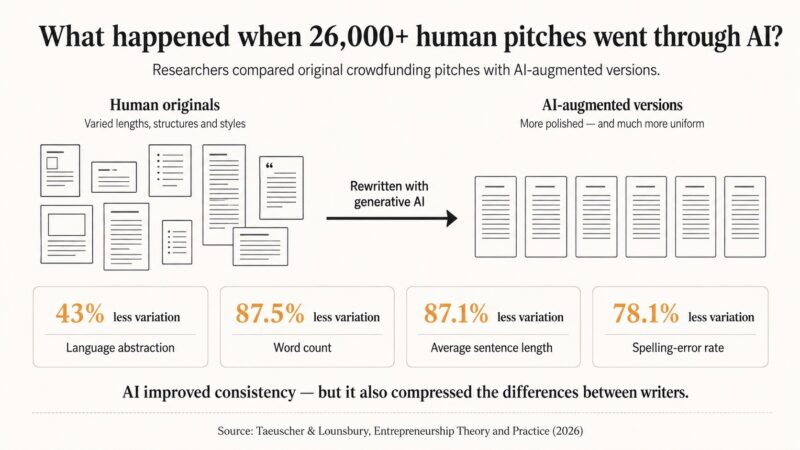
This creates a frustrating paradox for founders. For an individual business owner, using AI undeniably improves the quality of their immediate output. But collectively, as more founders adopt the technology, the overall environment becomes saturated with identical, high-quality prose.
If audiences are repeatedly exposed to these similar, AI-assisted communications, those linguistic patterns could quickly become the expected norm.
The researchers predict this will shift audience expectations in two key ways:
First, audiences may become desensitised to polished prose. When a beautifully written pitch is no longer a signal of a highly competent founder, but merely a signal of someone who knows how to write a basic AI prompt, the value of the writing itself drops.
Second, because AI is famously capable of producing plausible-sounding but empty statements, audiences may become much more demanding regarding evidence. A slick narrative may no longer be enough; evaluators may increasingly require hard data and verifiable claims to back up the story.
Why Human Skills Might Appreciate
If the researchers’ theory holds true, the implication for creators and founders is counterintuitive.
The temptation right now is to let AI handle the heavy lifting of external communications. But if AI makes it easy to be “good enough,” then “good enough” is no longer a competitive advantage.
“Business owners will still need to understand their audiences, recognise cultural expectations and know how to position their businesses in ways that are both credible and distinctive,” Dr Taeuscher noted. “The point is not that business owners should avoid these tools, but that using them well – and knowing when to depart from what they suggest – requires relevant skills and expertise.”
The researchers carefully caution that their paper presents a plausible scenario based on current trends, rather than an inevitable prediction. Both AI technology and the social norms surrounding it are evolving rapidly.
However, the central warning is difficult to ignore. In a market flooded with flawless, AI-generated pitches, the most radical thing a founder might do is sound like a human.